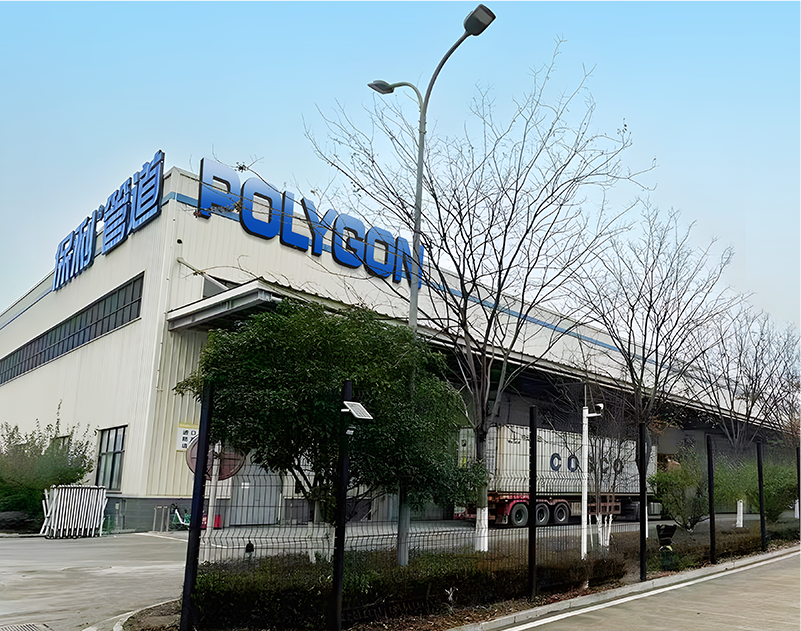

Did you know HDPE water pipes can last over 50 years? Choosing the right pipe is vital for safe water supply. HDPE pipes offer durability, flexibility, and corrosion resistance.
In this post, you’ll learn what HDPE water pipes are, why they matter, and how to select the best type for your project.
Table of Contents
Material Grades of HDPE Water Pipe
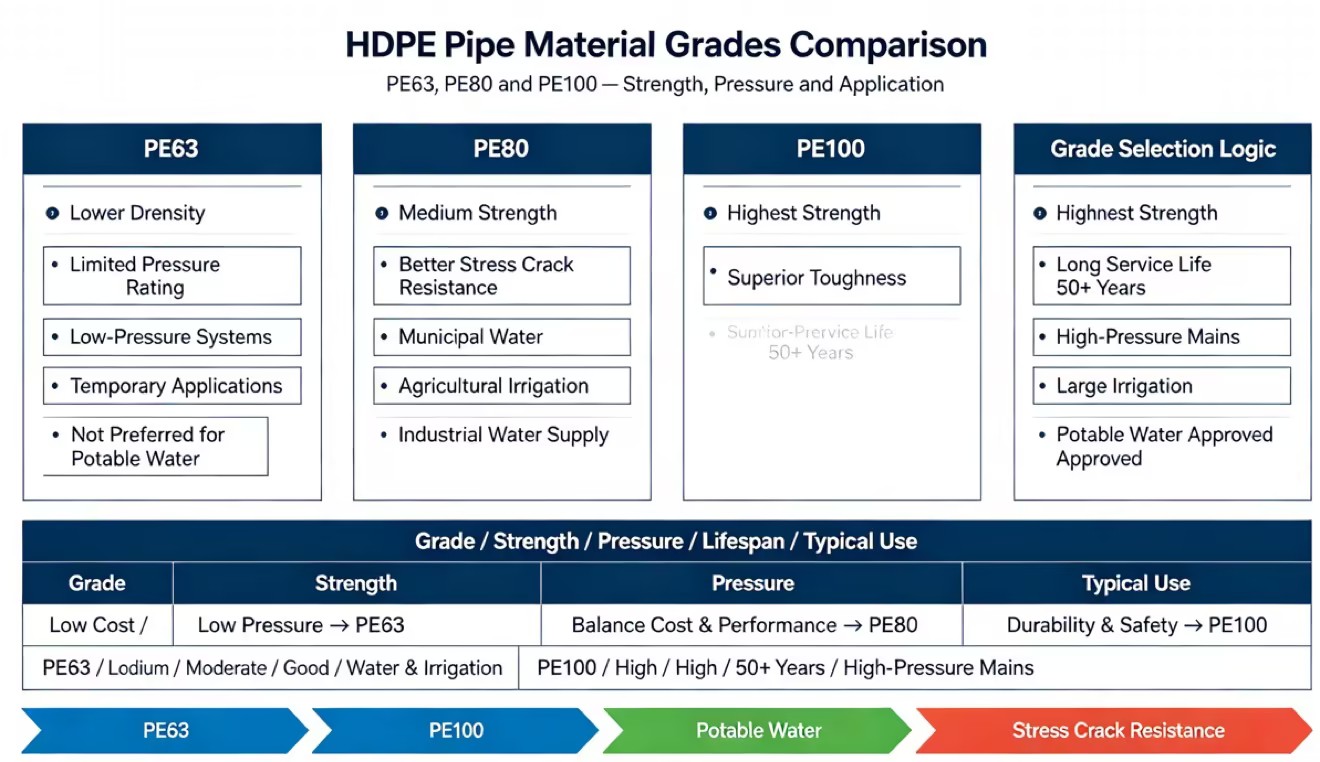
When selecting HDPE pipes for water supply projects, understanding the different material grades is crucial. The three main grades are PE63, PE80, and PE100. Each grade offers distinct characteristics, performance levels, and suitable applications.
PE63: Characteristics and Limitations
PE63 is an older grade of HDPE pipe material. It has lower density and strength compared to newer grades. Due to its limited pressure resistance and durability, PE63 is less common in modern water supply projects. It is mostly used in low-pressure or temporary applications, where cost is a primary concern and longevity is less critical.
Key points about PE63:
Lower tensile strength and impact resistance
Limited pressure rating, usually suitable for low-pressure systems
Less resistant to environmental stress cracking
Generally not recommended for potable water supply due to potential safety concerns
PE80: Suitable Applications and Performance
PE80 represents a medium-strength grade widely used across various water supply and gas distribution projects. It offers a good balance between cost and performance. PE80 pipes can handle moderate pressure levels and exhibit better resistance to stress cracking than PE63.
Typical uses for PE80 include:
Municipal water distribution networks
Agricultural irrigation systems
Industrial water supply lines
Moderate pressure gas pipelines
Advantages of PE80:
Improved strength and durability over PE63
Better chemical resistance and flexibility
Suitable for potable water applications when properly certified
PE100: Advantages for Water Supply Systems
PE100 is the highest grade of HDPE pipe material available today. It boasts superior strength, toughness, and long-term performance, making it the preferred choice for demanding water supply projects. PE100 pipes support higher pressure ratings and provide excellent resistance to environmental stress cracking, chemicals, and impact.
Benefits of PE100 include:
High tensile strength, enabling thinner walls and lighter pipes
Long service life, often exceeding 50 years under normal conditions
Enhanced safety margin for high-pressure water supply systems
Suitable for potable water, gas, and industrial applications
Because of these advantages, PE100 pipes are widely used in:
High-pressure municipal water mains
Large-scale irrigation projects
Industrial water transport systems
Gas distribution networks requiring robust materials
Tip: For water supply projects demanding durability and safety, prioritize PE100 pipes due to their superior strength and long service life.
Pressure Ratings and Their Impact on HDPE Water Pipe Selection
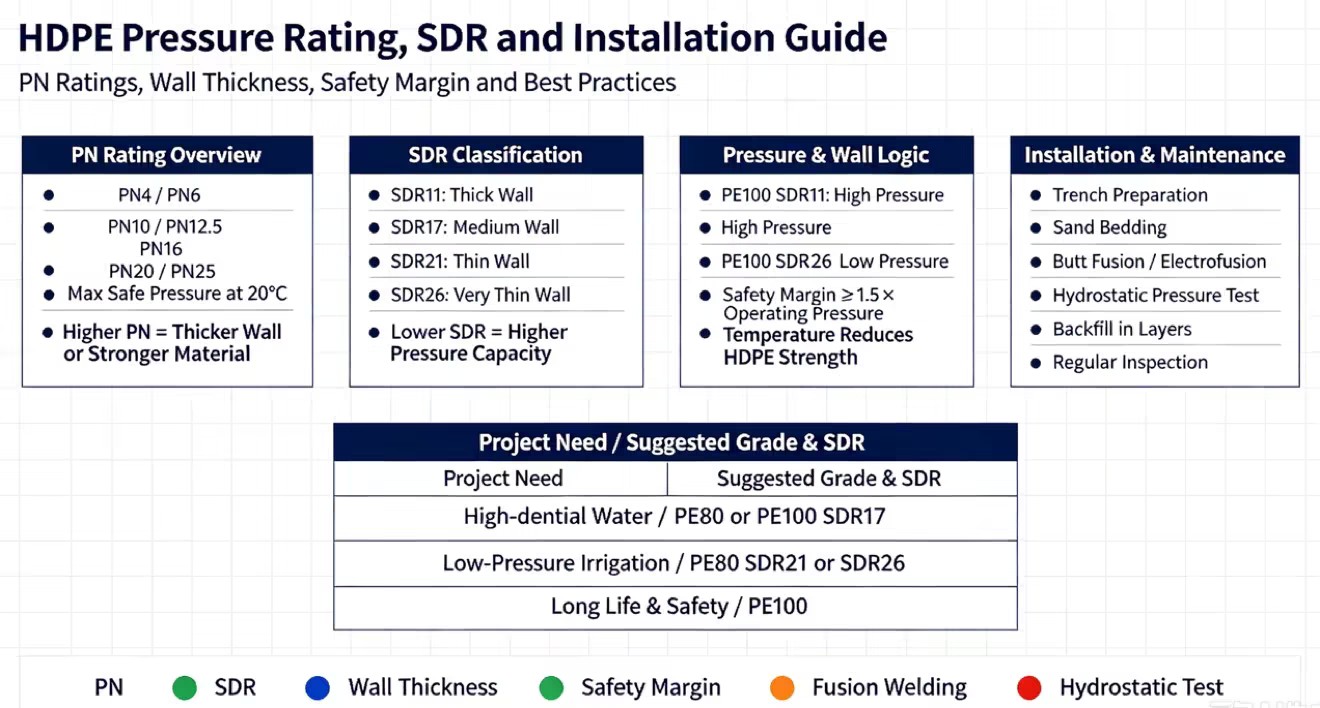
Understanding PN ratings (PN4, PN6, PN10, PN12.5, PN16, PN20, PN25)
Pressure Nominal (PN) ratings indicate the maximum pressure a pipe can handle at 20°C over a long period. They help you match the pipe to your project's pressure needs. Common PN ratings for HDPE pipes include:
PN4: Low-pressure systems, such as garden irrigation or drainage.
PN6: Moderate pressure, suitable for small water supply lines.
PN10: Standard pressure for many municipal water networks.
PN12.5: Higher pressure applications, often in industrial water systems.
PN16: High-pressure systems, including large water mains.
PN20 and PN25: Very high-pressure applications, such as specialized industrial or gas pipelines.
Each PN rating corresponds to a specific pressure the pipe can safely withstand. Choosing a pipe with a pressure rating too low risks leaks or bursts, while over-specifying can increase costs unnecessarily.
How pressure rating affects pipe durability and safety
The pressure rating directly relates to the pipe's wall thickness and material strength. Higher PN ratings require thicker walls or stronger material grades like PE100. This thickness helps resist internal pressure and external forces, reducing risk of failure.
Pipes with inadequate pressure ratings may deform, crack, or fail under pressure. This compromises water supply safety and can lead to costly repairs or contamination. Conversely, pipes rated well above the system pressure offer a safety margin, increasing durability and lifespan.
Environmental factors like temperature and water quality also affect pipe performance under pressure. For example, higher temperatures reduce HDPE strength, so selecting a pipe with a higher PN rating than the maximum operating pressure is wise.
Choosing the right pressure rating for your water supply project
To select the correct PN rating, consider:
Operating pressure: Measure the maximum pressure expected in the system.
Pressure surges: Account for pressure spikes from pumps or valves.
Temperature: Higher water temperatures require higher PN ratings.
Application type: Municipal, industrial, or irrigation systems have different pressure demands.
Safety factors: Include a margin above expected pressures for reliability.
For example, a municipal water main operating at 12 bar pressure would typically use PN16 pipes to ensure safety and durability. A small garden irrigation line running at 4 bar might only need PN6 pipes.
Consulting with engineers and suppliers can help balance cost and safety. Over-specifying increases material and installation costs, while under-specifying risks system failure.
Tip: Always select HDPE pipes with a PN rating at least 1.5 times higher than your system’s maximum operating pressure to ensure durability and safety over time.
Wall Thickness and SDR Classification of HDPE Water Pipes
What is SDR (Standard Dimension Ratio)?
SDR stands for Standard Dimension Ratio. It’s the ratio of a pipe’s outer diameter to its wall thickness. Simply put, SDR = Outside Diameter ÷ Wall Thickness. This ratio helps determine the pipe’s strength and pressure capacity. A lower SDR means thicker walls, making the pipe stronger and able to handle higher pressures. Conversely, a higher SDR means thinner walls, suitable for lower pressure needs.
Using SDR makes it easier to compare pipes of different sizes and thicknesses. It’s a universal way to classify pipes, regardless of diameter.
Common SDR values (SDR11, SDR17, SDR21, SDR26) and their uses
Here are some common SDR values you’ll find for HDPE water pipes, along with their typical applications:
SDR11: Thick walls, designed for high-pressure water supply systems. Used in municipal mains, industrial water lines, and wherever high durability is needed.
SDR17: Medium thickness walls, suitable for moderate pressure applications like residential water lines, irrigation systems, and smaller municipal networks.
SDR21: Thinner walls, usually for low-pressure water supply or drainage systems.
SDR26: The thinnest among common SDRs, used for very low-pressure applications such as garden irrigation or temporary water lines.
Choosing the right SDR depends on your system’s pressure requirements and safety margins.
How wall thickness influences pressure capacity and longevity
Wall thickness plays a key role in how much pressure a pipe can safely handle. Thicker walls resist internal pressure better, reducing the risk of bursting or deforming. This is why pipes with low SDR values (thicker walls) have higher pressure ratings.
Besides pressure, thicker walls also help pipes last longer. They better withstand external impacts, soil movement, and environmental stresses. Thinner walls may save material costs but could wear out faster or fail under harsh conditions.
For example, a PE100 pipe with SDR11 will handle higher pressure and last longer than a PE100 pipe with SDR26, even if both are made from the same material grade.
Tip: Always select an HDPE pipe with an SDR value that matches or exceeds your project’s pressure demands to ensure safety and durability over time.
Application-Based Considerations for HDPE Water Pipe
Compliance with potable water standards
When selecting HDPE pipes for water supply projects, ensuring compliance with potable water standards is critical. Pipes must meet regulatory requirements to guarantee water safety and prevent contamination. Common certifications include NSF/ANSI 61 in the U.S., WRAS in the UK, and other local standards. These certifications confirm the pipe material does not leach harmful substances and maintains water quality.
Using HDPE pipes certified for potable water helps protect public health and avoids costly replacements or legal issues. It also ensures the pipe is suitable for long-term use in drinking water systems.
Suitability for different water supply environments
HDPE pipes are versatile and perform well in various environments, but selecting the right type depends on specific conditions:
Municipal water systems: Require pipes with high pressure ratings and durability, often PE100 material with SDR11 or SDR17.
Rural or agricultural irrigation: Pipes may have lower pressure needs, allowing use of PE80 or PE100 with SDR21 or SDR26.
Industrial water supply: Pipes must resist chemicals and temperature variations, favoring PE100 with special additives.
Cold climates: HDPE pipes remain flexible and resist cracking, but selecting materials rated for low temperatures is advisable.
Underground installations: Pipes should withstand soil pressure and potential mechanical stresses. Double-walled or corrugated pipes may be preferred for drainage or protection.
Understanding the environment helps optimize pipe selection for performance and durability.
Comparing HDPE pipes to other water supply pipe materials
HDPE pipes offer several advantages over traditional materials like PVC, steel, or ductile iron:
Flexibility: HDPE pipes bend without cracking, reducing joint requirements and installation time.
Corrosion resistance: Unlike steel or iron, HDPE resists rust and chemical attack, extending lifespan.
Leak-free joints: Fusion welding creates seamless joints, minimizing leak risks.
Lightweight: Easier to transport and install compared to heavier metal pipes.
Longevity: HDPE pipes can last 50+ years under proper conditions.
Cost-effectiveness: Lower maintenance and installation costs often offset initial material prices.
However, HDPE may not be suitable for extremely high temperatures or certain chemical exposures. PVC pipes can be more rigid and cheaper for some applications, while steel pipes offer higher strength for very high-pressure systems.
Choosing between materials depends on project requirements, budget, and environmental factors.
Tip: Always verify HDPE pipes meet local potable water standards and select pipe types tailored to your specific water supply environment for optimal safety and performance.
Additional Types and Features of HDPE Water Pipes
Perforated HDPE Pipes for Drainage
Perforated HDPE pipes have small holes or slots along their length. These pipes are designed to collect and drain excess water from soil or other materials. They are commonly used in agricultural fields, sports turf, roadways, and landscaping to prevent waterlogging and improve soil stability.
Key benefits of perforated pipes include:
Efficient water drainage from saturated soil
Prevention of erosion and flooding
Easy installation in trench drains or subsurface drainage systems
Because of their drainage function, these pipes usually have thinner walls compared to pressure pipes and are not intended for carrying pressurized water.
Double-Walled Corrugated HDPE Pipes for Underground Systems
Double-walled corrugated HDPE pipes consist of a smooth inner wall and a corrugated outer wall. This design provides excellent strength and flexibility, making them ideal for underground drainage, sewerage, and stormwater management systems.
Advantages of double-walled corrugated pipes include:
High resistance to external soil pressure and impact
Lightweight and easy to handle during installation
Smooth inner surface reduces friction, improving flow efficiency
Flexibility to accommodate ground movement without cracking
These pipes are typically used in buried applications where durability and resistance to crushing forces are essential.
Special Features Enhancing Durability and Pressure Resistance
HDPE pipes come with various features that improve their durability and ability to withstand pressure:
UV Resistance: Pipes exposed to sunlight often include UV stabilizers to prevent degradation.
Antioxidant Additives: These protect the pipe material from oxidative damage during processing and service.
Enhanced Material Grades: PE100 and specially formulated compounds offer higher tensile strength and crack resistance.
Pressure-Resistant Wall Structures: Some pipes have reinforced walls or layered construction to handle higher pressures.
Corrosion and Chemical Resistance: HDPE naturally resists many chemicals, making it suitable for aggressive environments.
Selecting pipes with these features ensures long-term performance, especially in challenging environments or where safety margins are critical.
Tip: For underground drainage systems, choose double-walled corrugated HDPE pipes for superior strength and flexibility, while perforated pipes work best for soil drainage applications.
Installation and Maintenance Tips for HDPE Water Pipes
Best Practices for Installing HDPE Water Pipes
Proper installation ensures HDPE pipes perform well and last long. Follow these key steps:
Site Preparation: Clear debris, rocks, and sharp objects from the trench to avoid pipe damage.
Trench Dimensions: Maintain correct trench width and depth to support pipes and prevent soil movement.
Bedding Material: Use sand or fine gravel as bedding to cushion pipes and provide uniform support.
Pipe Handling: Avoid dragging pipes on rough surfaces; carry or roll carefully to prevent scratches or dents.
Joining Methods: Use butt fusion or electrofusion welding to create strong, leak-free joints.
Alignment: Lay pipes straight or with gentle curves to avoid stress points.
Backfilling: Place soil in layers, compact gently to avoid pipe deformation but ensure stability.
Pressure Testing: Conduct hydrostatic pressure tests after installation to check for leaks or weak joints.
Following these steps reduces risks of leaks, breaks, and premature failures.
Common Challenges and How to Avoid Them
Installing HDPE pipes can face several challenges. Here’s how to handle them:
Pipe Damage: Avoid sharp bends and impacts during transport and laying. Use protective covers if needed.
Improper Fusion Joints: Ensure fusion equipment is calibrated and operators trained. Poor joints cause leaks.
Soil Movement: In unstable soils, use proper bedding and backfill techniques, or consider pipe anchors.
Temperature Effects: HDPE expands/contracts with temperature. Leave expansion gaps or use flexible joints.
Incorrect Pressure Rating: Match pipe rating to system pressure to prevent bursting or deformation.
Water Contamination: Use pipes certified for potable water and clean pipes before installation.
Planning and quality control prevent most installation issues.
Maintenance Strategies to Extend Pipe Lifespan
HDPE pipes require minimal maintenance but some care helps extend their service life:
Regular Inspections: Check for visible damage, leaks, or ground shifts around buried pipes.
Pressure Monitoring: Track system pressure to detect unusual spikes or drops indicating problems.
Cleaning: Flush pipes periodically to remove sediment or biofilm buildup.
Repair: Fix leaks or cracks promptly using approved repair clamps or fusion methods.
Avoid Heavy Loads: Protect buried pipes from heavy machinery or traffic loads that exceed design limits.
Documentation: Keep records of pipe type, installation date, and maintenance history for future reference.
Routine maintenance ensures reliable water supply and reduces costly repairs.
Tip: Train installation crews on proper fusion welding and handling techniques to ensure leak-free HDPE pipe joints and long-term system reliability.
Conclusion
Choosing the right HDPE water pipe involves considering material grade, pressure rating, and wall thickness. Balancing cost with durability ensures pipes meet project demands effectively. Selecting certified pipes suitable for your environment improves safety and longevity. Proper installation and maintenance prevent failures and extend service life. For reliable, high-quality HDPE pipes that combine strength and flexibility, trust POLYGON products. They offer excellent value and support for successful water supply projects.
FAQ
Q: What is an HDPE water pipe?
A: An HDPE water pipe is a high-density polyethylene pipe used for water supply projects, known for its strength, flexibility, and resistance to corrosion.
Q: How do I choose the right HDPE water pipe grade?
A: Select based on project needs: PE63 for low pressure, PE80 for moderate pressure, and PE100 for high-pressure and long-term durability.
Q: Why is pressure rating important for HDPE water pipes?
A: Pressure ratings like PN10 or PN16 indicate the maximum safe operating pressure, ensuring the HDPE water pipe can handle system demands without failure.
Q: Are HDPE water pipes suitable for potable water?
A: Yes, certified HDPE water pipes, especially PE80 and PE100 grades, meet potable water standards and ensure safe drinking water.
Q: How does SDR affect HDPE water pipe performance?
A: SDR defines wall thickness; lower SDR means thicker walls, higher pressure capacity, and longer lifespan for HDPE water pipes.
Q: What are common installation challenges with HDPE water pipes?
A: Challenges include improper fusion joints, pipe damage, and incorrect pressure rating; proper handling and trained installation prevent these issues.
Q: How do HDPE water pipes compare to PVC pipes?
A: HDPE water pipes offer greater flexibility, corrosion resistance, and longer lifespan, making them preferable for many water supply projects.
Q: What maintenance is needed for HDPE water pipes?
A: Regular inspections, pressure monitoring, and timely repairs help extend the lifespan of HDPE water pipes and ensure system reliability.
Related Articles
CONTACT
Get in Touch With Us