
Did you know PPR pipe pressure rating isn't as simple as it seems? Many confuse PN ratings with actual working pressure. Understanding PN ratings and their link to temperature is crucial for safe piping.
In this post, you’ll learn what PN means, why temperature matters, and how to choose the right PPR pipe pressure rating.
What Does PN Mean in PPR Pipe Pressure Rating?
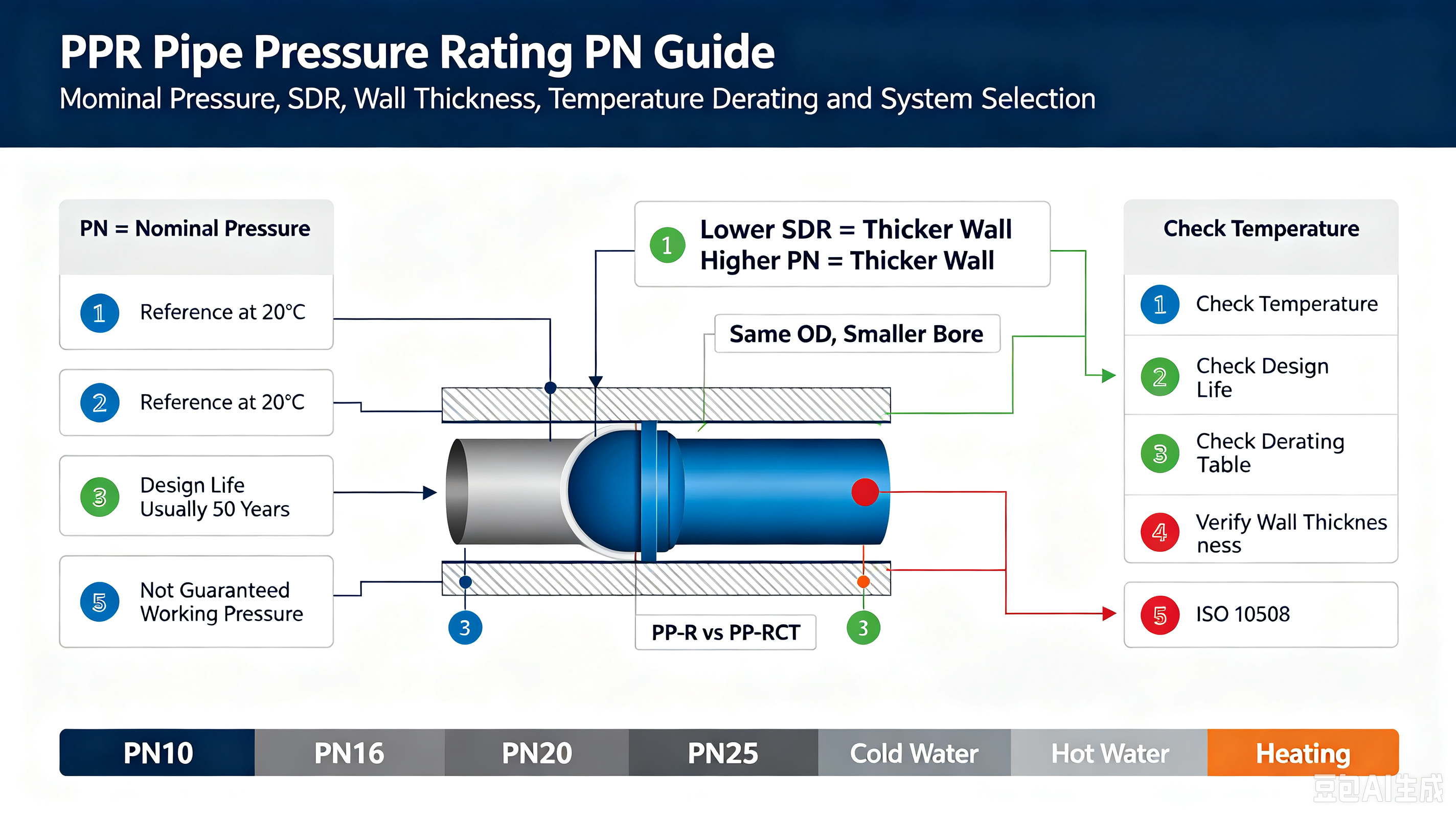
When you see "PN" on a PPR pipe, it stands for "nominal pressure," measured in bar. But it's important to understand exactly what this means. PN is a rating based on the pipe carrying a certain pressure at 20 °C over a nominal design life, usually 50 years. For example, a PN20 pipe is designed to handle roughly 20 bar at 20 °C over that long period. This rating isn't a promise of the pipe's working pressure in your system—it’s a reference point.
The design life plays a big role here. The longer the pipe is expected to last, the lower the pressure it can safely handle, especially at higher temperatures. So, if the design life changes, the PN rating effectively changes too, because the pipe must endure stress for a different amount of time.
Material grade also affects the PN rating. PPR pipes come in different polypropylene grades, like standard PP-R and enhanced PP-RCT. These grades differ in their long-term strength at elevated temperatures. For example, PP-RCT retains more strength at higher temperatures than standard PP-R. This means that for the same wall thickness, a PP-RCT pipe might have a higher PN rating or maintain its pressure capacity better at hot water temperatures. So, the PN number you see assumes a certain material grade, and if you switch grades, the pressure rating might not match exactly.
Another key point is that PN is a reference, not the guaranteed working pressure. Because polypropylene is a thermoplastic, its strength decreases as temperature rises. The pressure a pipe can safely handle at 20 °C will be much higher than what it can handle at 60 °C or 70 °C over time. This is why you can’t just take the PN number and assume the pipe will hold that pressure in your hot water system. You have to derate the pressure rating based on actual operating temperatures and design life.
In summary:
PN is the nominal pressure rating at 20 °C over a nominal design life.
Longer design life means lower permissible pressure.
Material grade impacts strength and pressure capacity.
PN is a reference, not a guaranteed working pressure in your system.
Understanding these points helps you specify the right pipe, avoid costly mistakes, and ensure safe, long-lasting installations.
Note: Always confirm the material grade and design life assumptions behind a PN rating before finalizing your specification to avoid under- or over-specifying your PPR pipes.
Relationship Between PN, SDR, and Wall Thickness in PPR Pipes
Understanding the link between PN, SDR, and wall thickness is key to specifying PPR pipes correctly. These three terms describe the same physical fact in different ways: how thick the pipe wall is compared to its outside diameter.
What Is SDR?
SDR stands for Standard Dimension Ratio. It's a simple ratio calculated by dividing the pipe’s outside diameter by its wall thickness:
SDR = Outside Diameter ÷ Wall ThicknessA lower SDR means the wall is thick relative to the diameter, making the pipe stronger and able to handle higher pressure. A higher SDR means a thinner wall and lower pressure capacity.
For example, an SDR of 6 means the outside diameter is six times the wall thickness. This is a thick wall, typical for higher pressure classes. An SDR of 11 means the wall is thinner and the pipe is designed for lower pressure.
How Wall Thickness Determines PN Class
The PN class is essentially a pressure rating, and it directly relates to wall thickness for a given outside diameter and material grade. Within one material grade, a higher PN class means a thicker wall.
Same outside diameter: The pipe’s external size stays the same so fittings and welding tools fit across classes.
Thicker wall: The wall grows inward, reducing the pipe’s internal bore.
Higher pressure capacity: Thicker walls withstand higher pressures, which means a higher PN rating.
For example, a PN20 pipe has a thicker wall than a PN16 pipe of the same diameter. This thicker wall allows it to handle roughly 20 bar at 20 °C, compared to 16 bar for PN16.
Effect of PN Class on Pipe Bore and Flow Capacity
Because the wall thickness increases as PN class rises, the internal bore (the pipe’s flow path) shrinks. This reduces flow capacity and can affect system hydraulics.
Smaller bore: Higher PN classes mean smaller internal diameters.
Lower flow rate: Smaller bores restrict water flow, which may require upsizing the pipe diameter to maintain flow.
Hydraulic check needed: After choosing a PN class, always recalculate flow velocity and pressure drop.
Ignoring this can cause underperformance, especially in long runs or systems with tight flow requirements.
Material Grade Influence on PN-SDR Correlation
The relationship between PN, SDR, and wall thickness assumes a specific material grade, usually standard polypropylene (PP-R). Different grades, like PP-RCT (a raised temperature grade), have higher long-term strength.
This means:
A PP-RCT pipe might achieve the same PN rating with a thinner wall (higher SDR).
Or, at the same wall thickness, it might have a higher PN rating than a standard PP-R pipe.
Always confirm the material grade when comparing PN and SDR values.
Summary Table: Typical PN and SDR Pairings for Standard PP-R
PN Class | Approximate SDR | Wall Thickness (relative) | Use Case |
|---|---|---|---|
PN10 | 11 | Thin | Cold water, low pressure |
PN16 | 7.4 | Medium | Higher pressure cold water |
PN20 | 6 | Thick | Hot and cold sanitary water |
PN25 | 5 (fiber composite) | Heaviest | Heating circuits, hot risers |
Note: PN25 often uses fiber-reinforced construction for added strength and reduced thermal expansion.
Tip: Always verify wall thickness and SDR on technical datasheets, as material grade changes can alter the PN-SDR relationship and affect pipe performance.
PPR Pipe Pressure Class Table Explained: PN10, PN16, PN20, PN25
When choosing PPR pipes, understanding the pressure classes helps you pick the right pipe for the job. The common classes are PN10, PN16, PN20, and PN25. Each class has specific characteristics, uses, and construction details that affect performance and cost.
Characteristics and Typical Use of PN10 Pipes
PN10 pipes have the thinnest walls among the classes. They are designed for about 10 bar pressure at 20 °C. Because of their light wall thickness, PN10 pipes are mainly used for cold water distribution and low-pressure lines like drains. They are not suitable for hot water or heating circuits due to limited strength at higher temperatures.
Features and Applications of PN16 Pipes
PN16 pipes have medium wall thickness and handle approximately 16 bar at 20 °C. They serve well in cold water systems with higher mains pressure or intermittent warm water service. While stronger than PN10, they still fall short for continuous hot water or heating applications. PN16 is a popular choice for cold water lines under moderate pressure.
Overview of PN20 as the General-Purpose Class
PN20 pipes are the heavy-duty option for most sanitary water uses. They carry roughly 20 bar at 20 °C and have thicker walls than PN16. This class is the most common for domestic hot and cold water systems. It balances strength, durability, and cost for general-purpose use. PN20 pipes can handle hot water temperatures better than PN10 or PN16, making them the minimum standard for hot water supply.
Special Properties of PN25 and Fiber-Reinforced Construction
PN25 pipes are the heaviest class, designed for about 25 bar at 20 °C. They often use fiber-reinforced multilayer construction, adding glass fibers inside the wall. This reinforcement boosts stiffness and hoop strength, essential for heating circuits and hot water risers where pressure and thermal expansion are concerns. The fiber layer also reduces thermal expansion, helping pipes withstand movement caused by heat. PN25 pipes are ideal for demanding applications but cost more due to their complex construction.
Common Specification Errors Related to PN Classes
Several mistakes happen when specifying PN classes:
Assuming PN20 means the pipe holds 20 bar under all conditions. In reality, pressure capacity drops with temperature.
Treating PN10 as suitable for hot water, which risks premature failure.
Confusing PN20 and PN25 as having the same wall thickness or SDR. PN25 has a thicker wall (lower SDR) than PN20.
Ordering pipes without specifying PN class, leading to receiving the lightest class by default.
Mixing different PN classes in the same system, reducing overall reliability.
Ignoring bore reduction as wall thickness increases, which affects flow capacity.
Avoid these errors by clearly stating the required PN class, understanding temperature effects, and verifying wall thickness on datasheets.
Tip: Always check that PN25 pipes have fiber reinforcement and a thicker wall than PN20 to ensure they meet heating circuit demands.
Temperature Derating and Its Effect on PPR Pipe Pressure Rating
Understanding how temperature affects PPR pipe pressure ratings is crucial. The key fact: as operating temperature rises, the pipe’s permissible pressure drops. This happens because polypropylene is a thermoplastic. Its long-term strength decreases when exposed to heat over time.
How Operating Temperature Reduces Permissible Pressure
At 20 °C, the PN rating roughly matches the pipe’s working pressure. But as temperature climbs, the polymer softens, and the pipe can’t hold as much pressure safely. For example, a PN20 pipe designed for 20 bar at 20 °C might only handle around 6–8 bar at 70 °C over its design life.
This reduction isn’t sudden. It’s gradual and depends on how long the pipe must last under those conditions. The longer the design life, the lower the allowable pressure at elevated temperatures.
Derating Differences Between Cold Water and Hot Water Service
Cold water systems operate near the reference temperature, so the PN rating is a good guide. In hot water systems (60–70 °C), the pressure rating must be derated significantly. PN10 pipes, while fine for cold water, become unsafe for hot water because their thin walls can’t handle the reduced pressure capacity.
Heating circuits, often hotter and under constant pressure, require even heavier classes, like fiber-reinforced PN25 pipes. These pipes resist higher temperatures and pressures better, partly due to their reinforced structure.
Impact of Design Life on Pressure Rating at Elevated Temperatures
Design life is the hidden axis in pressure rating. A pipe rated for 50 years at a certain pressure and temperature can carry more pressure if the design life shortens to 10 or 20 years. Conversely, longer design life demands lower pressure ratings to prevent premature failure.
Manufacturers provide derating tables showing permissible pressure versus temperature and design life. These tables help specifiers pick the right class for the expected service conditions.
Application Classes According to ISO 10508 and Their Significance
ISO 10508 defines application classes linking service conditions to pipe performance. Instead of a single pressure number, pipes are declared for classes that describe temperature profiles and durations.
Common classes include:
Class 1: Lower-temperature hot water (~60 °C)
Class 2: Higher-temperature hot water (~70 °C)
Class 4: Underfloor heating, low-temperature radiators
Class 5: Higher-temperature radiator heating
Cold: Cold water service (~20 °C)
Specifying a pipe by application class plus design pressure ensures clarity. For example, a pipe rated for Class 2 at 6 bar is suitable for 70 °C hot water at that pressure over the design life.
Why PN20 Is Not 20 Bar in Hot Water Applications
Many assume PN20 means the pipe holds 20 bar regardless of temperature. This is false. At hot water temperatures, the allowable pressure is much lower. The PN20 label refers only to the 20 °C rating.
Using a PN20 pipe in hot water without derating risks failure. Always consult derating tables and application class declarations. This ensures the pipe matches system pressure and temperature safely.
Tip: Always consult the manufacturer’s temperature-pressure derating tables and ISO 10508 application classes before finalizing PPR pipe specifications for hot or heating water systems.
Practical Guide to Choosing the Right PPR Pipe Pressure Rating
Choosing the correct PN class for PPR pipes isn’t just about picking a number. It’s a step-by-step process that ensures safety, performance, and cost-effectiveness. Here’s how to get it right.
Start with Service Temperature, Not Pressure
The first question: what temperature will the pipe carry continuously? Cold water lines around 20 °C can usually use lighter classes like PN10 or PN16. Hot water systems at 60–70 °C need heavier classes like PN20 or PN25. Temperature affects the pipe’s strength far more than pressure alone. So, always identify the operating temperature first. This sets the minimum PN class you should consider.
Calculate Real System Pressure Including Transients
Don’t just use the static pressure on paper. Real systems have pressure spikes from pumps starting or stopping, water hammer, and static head in tall buildings. These transient pressures can be much higher than the average. Calculate the worst-case pressure at the highest point in the system, including these factors. This pressure must be within the pipe’s derated pressure rating for the expected temperature and design life.
Use Derating Tables to Confirm Suitable PN Class
Once you know temperature and pressure, check the manufacturer’s derating tables. These show how the nominal PN rating drops as temperature rises and over the pipe’s design life. For example, a PN20 pipe may only safely carry 8 bar at 70 °C over 50 years. If your system pressure exceeds this derated value, choose a higher PN class or a pipe with reinforced construction. Skipping this step is a common cause of under-specification.
Recheck Hydraulic Sizing After Selecting Pipe Class
Higher PN classes mean thicker walls and smaller internal bores. This reduces flow capacity. After picking the PN class, recalculate flow velocity and pressure drop to ensure the pipe diameter still meets system requirements. If flow is restricted, increase the pipe diameter rather than lowering the pressure class. This keeps the system balanced and efficient.
Avoid Over-Specification and Under-Specification
Over-specifying means paying for heavier pipes than necessary, increasing cost and weight. Under-specifying risks leaks, failures, and costly repairs. Balance is key. Follow the steps above carefully, and consult technical datasheets and standards. When in doubt, ask the manufacturer for guidance based on your exact conditions.
Tip: Always verify your system’s maximum operating temperature and pressure, then use the pipe’s derating table to pick a PN class that safely exceeds those conditions over the design life.
Common Specification Errors in PPR Pipe Pressure Rating and How to Avoid Them
Specifying PPR pipes correctly is crucial to avoid costly mistakes. Many errors stem from misunderstanding PN ratings or skipping essential checks. Here are the common pitfalls and how to fix them.
Ordering Pipes Without Specifying PN Class
Simply ordering "PPR pipe" by diameter and quantity invites the lightest legal pipe. Suppliers often default to PN10 or the lowest class available, which may not suit your system. Always specify the PN class explicitly on every order line. Include the governing standard too, so there’s no guesswork.
Misinterpreting PN as Actual Working Pressure
PN ratings are nominal values at 20 °C over a design life, not guaranteed working pressures. Many assume PN20 means the pipe safely holds 20 bar at any temperature. This is false. Hot water or heating circuits reduce allowable pressure significantly. Always derate PN values for actual service temperature and design life before comparing with system pressure.
Comparing Prices Without Considering Wall Thickness and Weight
A cheaper price per meter usually means a lighter pipe with thinner walls. This can cause premature failure if the pipe is under-classed for the application. Don’t compare only price. Check weight per meter and wall thickness on datasheets to confirm the PN class matches your needs.
Mixing Different PN Classes Within the Same Circuit
A system’s pressure rating depends on its weakest part. Using different PN classes in one circuit lowers overall reliability. For example, welding PN20 pipe to PN10 fittings creates a weak point. Specify pipe, fittings, and valves as a matched system rated for the same PN class.
Ignoring Bore Reduction in Heavier PN Classes
Higher PN classes have thicker walls, shrinking the internal bore. This reduces flow capacity and may cause low pressure at the far end. If you upgrade to a heavier class, always re-check hydraulic calculations. You might need to increase pipe diameter to maintain flow.
Neglecting Thermal Expansion in Hot Water Systems
PPR pipes expand as temperature rises, especially in hot water or heating circuits. Pressure class alone doesn’t solve this. Failure to allow for expansion causes stress, leaks, or joint failures. Use fiber-reinforced PN25 pipes for hot circuits. Design expansion loops and proper bracket spacing into the system.
Tip: Always specify diameter, PN class, and governing standard on purchase orders to avoid receiving under-classed pipes and ensure system safety.
Ensuring Quality and Consistency in PPR Pipe Pressure Rating
Ensuring quality and consistency in PPR pipe pressure ratings is essential for reliable, long-lasting piping systems. The pressure class depends on precise manufacturing, material quality, and matched components. Here’s what you need to know to get it right.
Importance of Sourcing from Certified Manufacturers
Always buy PPR pipes from certified manufacturers with a proven track record. Certifications like ISO 9001, ISO 14001, and CE mark show the company follows strict quality control and environmental standards. These manufacturers maintain consistent wall thickness, material composition, and pressure class across production batches.
Avoid unknown or unverified suppliers. Pipes from uncertified sources may have inconsistent wall thickness or use substandard resin, risking early failure or leaks. Certified manufacturers provide documentation and test reports, giving you confidence in the product’s performance.
Verifying Pipe Class Through Wall Thickness and Weight Measurement
Because PPR pipes of different PN classes share the same outside diameter, you cannot judge pressure class by appearance alone. The wall thickness and weight per meter are the true indicators.
When pipes arrive, measure the wall thickness with a caliper and weigh a known length. Compare these values to the manufacturer’s datasheet. If the wall is thinner or the weight lighter than specified, the pipe is likely under-classed and unsafe for your system.
Periodic verification during production or on-site helps catch errors early. This simple check prevents costly mistakes like installing pipes that fail pressure tests or degrade prematurely.
Matching Pipe, Fittings, and Valves as a System
A PPR piping system’s strength depends on all parts being rated for the same pressure class. Using PN20 pipes with PN10 fittings or valves reduces the system’s overall pressure rating to the weakest link.
Specify pipe, fittings, and valves from the same manufacturer or product line designed to work together at the chosen PN class. This ensures compatibility in dimensions, materials, and pressure ratings.
Mismatched components can cause joint failures, leaks, or bursts, especially under pressure spikes or thermal stress. A matched system also simplifies installation and maintenance.
Standards Governing PPR Pipe Dimensions and Pressure Classes
PPR pipes follow international standards such as DIN 8077, DIN 8078, and GB/T 18742.2-2017. These standards define pipe dimensions, wall thickness tolerances, pressure classes, and material requirements.
Ensure your supplier’s products comply with these or equivalent standards. Compliance guarantees interchangeability, pressure rating accuracy, and long-term durability.
Request certificates of conformity and test reports. These documents confirm the pipes meet dimensional and pressure class requirements.
Benefits of Single-Source Supply for Pressure Class Consistency
Sourcing pipes, fittings, and valves from a single manufacturer or supplier brings many benefits:
Consistent quality: Same production standards, materials, and quality control.
Simplified documentation: One set of certificates and datasheets for the whole system.
Better technical support: Manufacturer understands the full system and can provide tailored advice.
Reduced risk of incompatibility: Components designed to fit and perform together.
Streamlined logistics: Fewer suppliers, easier ordering, and faster delivery.
This approach reduces installation errors and improves system reliability.
Tip: Always verify PPR pipe wall thickness and weight against datasheets upon delivery to confirm the pressure class and avoid costly installation mistakes.
Conclusion
Mastering PPR pipe pressure ratings ensures safe, efficient system performance. PN ratings indicate nominal pressure at 20 °C but must be derated for temperature. Accurate specification and verification of material grade and wall thickness prevent costly mistakes. Always consult technical datasheets and standards for reliable guidance. Selecting the right pressure rating balances safety, durability, and cost. www.akanpolygon.com POLYGON offers high-quality PPR pipes designed for consistent pressure ratings and long-term reliability, helping you achieve optimal piping solutions.
FAQ
Q: What is a PPR pipe pressure rating and what does PN mean?
A: PPR pipe pressure rating indicates the nominal pressure a pipe can handle at 20 °C over its design life. PN stands for "nominal pressure," measured in bar, and represents this rating, not the actual working pressure in your system.
Q: How does temperature affect PPR pipe pressure rating?
A: As temperature rises, the PPR pipe pressure rating decreases because polypropylene weakens with heat. For example, a PN20 pipe rated for 20 bar at 20 °C may only handle around 6–8 bar at 70 °C.
Q: Why is it important to specify the correct PPR pipe pressure rating?
A: Correct PPR pipe pressure rating ensures safety, durability, and cost-effectiveness. Under-specifying risks failures, while over-specifying increases cost and weight unnecessarily.
Q: How do material grades influence PPR pipe pressure rating?
A: Different polypropylene grades, like standard PP-R and enhanced PP-RCT, affect the pipe’s strength and pressure rating. PP-RCT pipes maintain higher pressure capacity at elevated temperatures.
Q: What common errors should I avoid when specifying PPR pipe pressure rating?
A: Avoid ordering pipes without specifying PN class, misinterpreting PN as working pressure, mixing PN classes in one system, and ignoring temperature derating and bore reduction.
Related Articles
CONTACT
Get in Touch With Us