
Are you sure your plumbing uses the best pipes for hot and cold water? Choosing the right PPR pipe is vital for safety and efficiency. PPR pipes are growing popular in both homes and businesses.
In this post, you’ll learn how to select the right PPR pipe for your water system. We’ll cover key features, applications, and important selection tips.
Table of Contents
Understanding PPR Pipe Material Properties
Molecular Structure of Polypropylene Random Copolymer
PPR pipes are made from polypropylene random copolymer, a special type of plastic. This material contains a small amount of ethylene randomly mixed into the polypropylene chain. This random distribution makes the pipe more flexible and less brittle compared to regular polypropylene. It also improves resistance to heat and pressure over time.
This molecular structure helps the pipe handle hot water systems better. The flexibility reduces the chance of cracking during installation or use. Plus, it keeps the pipe strong even after years of exposure to hot water and pressure.
Thermal Conductivity and Energy Efficiency Benefits
One big advantage of PPR pipes is their low thermal conductivity, about 0.24 W/m·K. This means they don’t let heat escape easily. For hot water systems, this helps keep water warm while it travels through the pipes, saving energy. For cold water systems, it prevents condensation on the pipe surface, protecting walls and ceilings from moisture damage.
Compared to metal pipes like copper, which have very high thermal conductivity, PPR pipes provide better insulation naturally. This can reduce the need for extra insulation materials, cutting installation costs and improving energy efficiency.
Corrosion Resistance and Chemical Stability
PPR pipes do not corrode or rust, unlike metal pipes. They resist common chemicals found in water, so they don’t degrade or release harmful substances. This makes them safe for drinking water systems.
Their chemical stability also means they won’t develop scale or deposits inside, which can reduce water flow in metal pipes. The pipes maintain clean internal surfaces, protecting water quality and ensuring consistent flow.
Hydraulic Performance and Internal Surface Characteristics
Inside, PPR pipes have very smooth surfaces. The absolute roughness is about 0.007 mm, which is extremely low. This smoothness reduces friction, allowing water to flow easily and maintaining steady pressure.
Since the pipe doesn’t accumulate mineral deposits, the internal diameter stays constant over time. This means the system’s hydraulic performance remains stable, avoiding pressure drops or flow restrictions.
Tip: Always verify that your PPR pipes are made from 100% virgin polypropylene random copolymer to ensure optimal thermal insulation, corrosion resistance, and long-term durability for your hot and cold water systems.
PPR Pipe Performance Limits: Temperature, Pressure, and Lifespan
Standard Dimension Ratio (SDR) and Pressure Ratings
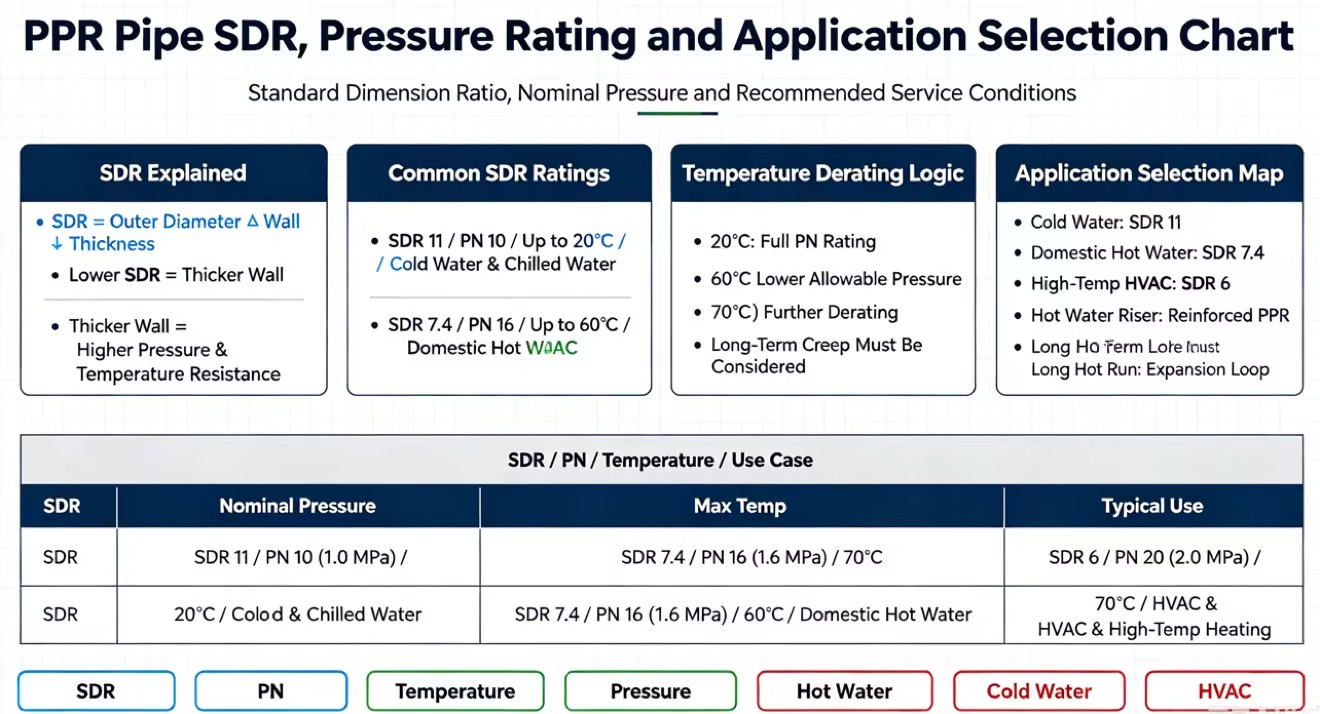
PPR pipes come in different Standard Dimension Ratios (SDR). SDR is the ratio of the pipe’s outer diameter to its wall thickness. A lower SDR means a thicker wall, which can handle more pressure and higher temperatures.
Here’s a quick look at common SDR values and their pressure ratings:
SDR | Nominal Pressure (PN) | Suitable Temperature Range | Typical Use |
|---|---|---|---|
SDR 11 | PN 10 (1.0 MPa) | Up to 20°C | Cold water, chilled water |
SDR 7.4 | PN 16 (1.6 MPa) | Up to 60°C | Domestic hot water |
SDR 6 | PN 20 (2.0 MPa) | Up to 70°C | High-temp heating, HVAC |
Choosing the right SDR is key. Pipes with thicker walls (lower SDR) handle hot water systems better because they resist pressure loss and deformation over time.
Temperature-Pressure Relationship and Derating Factors
PPR pipes’ ability to withstand pressure decreases as temperature increases. This means a pipe rated for a certain pressure at 20°C will handle less pressure at 60°C or 70°C.
For example, a PN20 pipe rated at 20°C might only safely handle about half that pressure at 70°C over many years. This is called temperature derating.
Designers must consider this derating when selecting pipes for hot water systems. Ignoring it can lead to pipe failure from long-term stress.
Thermal Expansion and Its Impact on System Design
PPR pipes expand when heated. The thermal expansion coefficient is relatively high compared to metal pipes. For every meter of pipe, the length can increase by several millimeters when the water temperature rises.
This expansion can cause stress on joints, fittings, and supports if not planned for. To manage this:
Use expansion loops or bends in long pipe runs.
Install proper pipe supports allowing movement.
Consider reinforced PPR pipes for hot water systems, as they have lower expansion rates.
Ignoring thermal expansion can lead to cracks, leaks, or joint failure over time.
Long-Term Strength and Creep Behavior of PPR Pipes
PPR is a viscoelastic material, meaning it slowly deforms under constant stress. This slow deformation is called creep.
Under continuous pressure and elevated temperature, the pipe walls may stretch or thin over decades. This weakens the pipe, potentially causing leaks or bursts.
Standards like ISO 15874 require pipes to be tested for long-term strength over 50 years at specified temperatures and pressures. Choosing pipes rated for your system’s conditions ensures they can handle creep and last the expected lifespan.
Tip: Always select PPR pipes with an SDR and pressure rating that match or exceed your system’s maximum operating temperature and pressure to prevent premature failure due to creep and thermal stress.
How to Choose the Right PPR Pipe for Hot and Cold Water Systems
Identifying PPR Pipes: Markings and Color Codes
Choosing the right PPR pipe starts by correctly identifying it. Most manufacturers print essential details directly on the pipe surface. Look for markings including:
Manufacturer’s name
Material type (e.g., PP-R or PP-RCT)
SDR value (Standard Dimension Ratio)
Nominal pressure rating (PN)
Application class
Production date and batch number
These markings ensure traceability and confirm pipe suitability for your project.
Color codes also help, though they vary between manufacturers. Commonly, blue stripes indicate cold water pipes, and red stripes signal hot water use. However, some pipes share base colors like green or white and rely solely on printed data. Never rely only on color; always check printed specs.
Selecting Appropriate SDR for Hot vs. Cold Water Applications
SDR defines the pipe’s wall thickness relative to its diameter. Lower SDR means thicker walls, which handle higher pressure and temperature.
SDR 11: Thinner walls, suitable for cold water and chilled water systems.
SDR 7.4: Medium thickness, ideal for domestic hot water.
SDR 6: Thickest walls, best for high-temperature heating and HVAC.
For hot water, pick pipes with lower SDR (7.4 or 6) to resist heat and pressure. Cold water pipes can use SDR 11 safely, offering cost savings and easier handling.
Standard vs. Reinforced PPR Pipe Types
Standard PPR pipes consist of a single polypropylene layer. They work well for cold water or low-temperature hot water.
Reinforced PPR pipes include additional layers like glass fiber or aluminum. These reduce thermal expansion and improve dimensional stability. Use reinforced pipes for:
Long hot water runs
Vertical risers in high-rise buildings
Systems needing oxygen barriers (aluminum layers)
Reinforced pipes cost more but prevent stress on joints and fittings over time.
Ensuring Compatibility with Application Temperature and Pressure
Always match pipe pressure ratings to your system’s maximum operating temperature and pressure.
Pipes rated PN20 or PN25 suit hot water systems up to 70°C.
Pipes rated PN10 or PN16 are for cold water only.
Using cold-rated pipes in hot water systems risks softening, deformation, and leaks. Hot-rated pipes can be used safely in cold water systems, adding durability.
Environmental Considerations: UV Resistance and Opacity
PPR pipes can degrade under UV light. For outdoor or sun-exposed installations:
Use UV-stabilized pipes or
Shield pipes with insulation, coatings, or physical covers
Opacity matters for potable water pipes. Pipes should block light to prevent algae growth. Verify opacity compliance per ISO 15874.
Code Compliance and Certification Standards
Always source pipes certified to relevant standards for safety and durability:
ISO 15874: International standard for plastic piping in hot and cold water.
DIN 8077 / 8078: German standards for dimensions and stress testing.
NSF/ANSI 14 & 61: North American safety and health certifications.
WRAS (UK) & WaterMark (Australia): Regional approvals for potable water.
Certification ensures pipes meet strict quality and performance criteria, reducing risk of failure.
Tip: Always verify pipe markings and certifications before purchase to ensure correct SDR, pressure rating, and compliance for your specific hot or cold water application.
PPR Pipe Installation Best Practices
Heat Fusion Process and Required Parameters
Installing PPR pipes requires precise heat fusion to create strong, leak-proof joints. Unlike mechanical fittings, heat fusion melts pipe ends and fittings together, forming a single solid piece.
The welding tool must be preheated to about 260°C (±5°C). Both pipe and fitting surfaces heat simultaneously. After heating, quickly join them and hold steady until the joint cools.
Timing is critical. For example:
Pipe Diameter | Heating Time | Welding Time | Cooling Time |
|---|---|---|---|
20 mm | 5 seconds | 4 seconds | 2 minutes |
25 mm | 7 seconds | 4 seconds | 2 minutes |
32 mm | 8 seconds | 6 seconds | 4 minutes |
Cold or hot weather affects these times. In cold environments below 5°C, increase heating time by 50% to avoid weak "cold fusion" joints.
Proper fusion ensures joints are stronger than the pipe itself, preventing leaks and failures during operation.
Managing Thermal Expansion During Installation
PPR pipes expand when heated, sometimes several millimeters per meter. If unaccounted for, this expansion stresses joints and fittings, causing cracks or leaks.
To manage thermal expansion:
Include expansion loops (U-shaped bends) in long runs.
Use sliding supports that allow pipe movement.
Avoid rigid clamps that restrict expansion.
Consider reinforced PPR pipes, which reduce expansion.
Planning for expansion during installation protects the system’s integrity and extends its lifespan.
Common Installation Mistakes and How to Avoid Them
Even with quality materials, poor installation can cause failures. Common mistakes include:
Overheating: Excess heat pushes melted material inward, narrowing the pipe bore and reducing flow.
Cold Joints: Joining pipe and fitting too slowly or at wrong temperature leads to weak bonds that fail under pressure.
Contamination: Dirt, oil, or moisture on fusion surfaces prevents proper bonding, causing leaks.
Improper Alignment: Misaligned pipes cause stress on joints and uneven flow.
Avoid these by:
Using calibrated fusion equipment.
Cleaning surfaces before welding.
Following precise heating and joining times.
Aligning pipes carefully before fusion.
Pressure Testing and Final System Validation
After installation, pressure testing verifies joint integrity. The system is filled with water or air and pressurized to the design pressure.
Monitor pressure for leaks or drops over a set time (usually 30 minutes). Any pressure loss signals a defect requiring repair.
Pressure testing before concealing pipes in walls or floors prevents costly future repairs and ensures system reliability.
Tip: Always calibrate fusion equipment and strictly follow heating, welding, and cooling times to avoid weak joints and ensure long-lasting PPR pipe installations.
Maintenance, Troubleshooting, and Lifespan Management of PPR Pipes
Environmental Factors Affecting PPR Pipe Longevity
PPR pipes are known for durability, but environmental exposure can still affect lifespan. One major factor is UV radiation. Prolonged sunlight exposure causes surface whitening, cracking, and brittleness. Pipes outdoors or on rooftops must have UV protection through coatings, insulation, or special UV-stabilized materials.
Chemical exposure also matters. While PPR resists many chemicals, harsh substances like hydrocarbons or strong oxidizers can weaken pipes over time. Industrial or mixed-use buildings should keep piping isolated from such agents. Regular inspections help spot early damage from environmental stress.
Temperature fluctuations beyond design limits accelerate material aging. Avoid exposing pipes to temperatures above their rated continuous operation. Sudden temperature spikes can cause micro-cracks or joint stress.
Common Operational Issues and Their Solutions
Though low maintenance, PPR systems can face operational challenges:
Water hammer noise: Sudden valve closures create pressure surges, causing banging sounds. Properly securing pipes and installing water hammer arrestors reduces noise and pipe movement.
Pressure drops or flow reduction: Usually caused by debris clogging strainers or fittings. Regular cleaning restores flow. If present from installation, suspect fusion defects like over-melting restricting diameter; pipe section replacement is needed.
Leaks at joints: Often due to poor fusion or contamination during installation. Pressure test after installation to catch and fix leaks early.
Brittleness or cracking: Typically from UV damage or chemical exposure. Replace affected sections and improve protection.
Routine visual checks and pressure monitoring help detect issues early.
Lifecycle Cost Benefits of Using PPR Pipes
PPR pipes offer excellent value over their service life:
Energy savings: Low thermal conductivity keeps hot water hot and cold water cool, reducing heating/cooling costs.
Reduced maintenance: No corrosion or scaling means fewer repairs and longer intervals between inspections.
Long lifespan: Designed for 50 years under proper conditions, minimizing replacement frequency.
Easier repairs: Localized fusion repairs avoid dismantling large sections, saving time and money.
Lower noise: PPR absorbs water hammer better than metal pipes, reducing noise complaints and structural wear.
Considering total cost of ownership, PPR pipes often outperform traditional metal or PVC systems.
Tips for Ensuring Long-Term System Reliability
To maximize PPR system life:
Always protect pipes from UV exposure outdoors.
Use only certified pipes matching system temperature and pressure.
Follow heat fusion procedures precisely during installation.
Incorporate expansion loops or supports to handle thermal movement.
Perform pressure testing before concealing pipes.
Schedule periodic inspections for leaks, noise, and physical damage.
Keep piping isolated from harsh chemicals or solvents.
Clean strainers and filters regularly to prevent clogging.
Train maintenance staff on PPR system specifics.
Good lifecycle management ensures your PPR system delivers decades of trouble-free service.
Tip: Regularly inspect and protect PPR pipes from UV and chemical exposure to prevent premature aging and maintain system reliability.
Partnering with Certified PPR Pipe Manufacturers
Importance of Sourcing from Trusted Manufacturers
Choosing a reliable PPR pipe manufacturer is crucial for ensuring system safety, durability, and compliance. Trusted manufacturers use 100% virgin polypropylene random copolymer resin, guaranteeing pipes meet strict quality standards. This ensures consistent wall thickness, pressure ratings, and thermal resistance needed for hot and cold water systems.
Working with certified suppliers reduces risks of receiving substandard or recycled-material pipes, which can lead to brittleness, premature cracking, or poor thermal performance. Certified manufacturers also provide traceability through batch numbers and production dates, enabling quality control and accountability.
Benefits of 100% Virgin PPR Resin Pipes
Pipes made from 100% virgin resin offer superior mechanical strength and longevity. Virgin resin maintains high oxidative induction time (OIT), meaning the material resists degradation from heat and oxygen over decades. This keeps pipes stable under continuous hot water exposure and pressure.
Using virgin resin also ensures uniform molecular structure, which translates to better fusion joint quality and fewer installation defects. Pipes made from recycled or blended materials often have inconsistent properties, increasing failure risk.
Custom OEM Options and Global Logistics Support
Leading manufacturers offer custom OEM services, allowing clients to specify wall thickness, pipe colors, and branding to fit project needs. This flexibility helps meet local regulations or client preferences.
Global logistics support is another key advantage. Certified suppliers manage container optimization, customs documentation, and timely delivery, ensuring smooth supply chains for large projects or distributors.
Ensuring Compliance with International Standards
Certified PPR pipe manufacturers comply with international standards such as:
ISO 15874: Governs plastic piping systems for hot and cold water.
DIN 8077 / 8078: German standards for dimensions and hydrostatic testing.
NSF/ANSI 14 & 61: Safety and health certifications for potable water.
WRAS (UK) and WaterMark (Australia): Regional approvals ensuring public health safety.
Compliance guarantees pipes perform reliably and meet legal requirements in various markets. It also facilitates project approvals and reduces liability.
Tip: Always verify manufacturer certifications and request material batch test reports before purchasing PPR pipes to ensure compliance and long-term system reliability.
Conclusion
Choosing the right PPR pipe involves understanding material properties, SDR ratings, and installation best practices. Proper selection ensures durability and energy efficiency in hot and cold water systems. Long-term performance depends on managing thermal expansion, pressure limits, and using certified pipes. For project-specific needs, consulting experts guarantees optimal pipe choice and system design. www.akanpolygon.com POLYGON offers high-quality PPR pipes made from 100% virgin resin, delivering reliable performance and excellent value for any water system.
FAQ
Q: What is a PPR pipe and why is it used in hot and cold water systems?
A: A PPR pipe is made from polypropylene random copolymer, offering flexibility, heat resistance, and corrosion resistance, making it ideal for both hot and cold water systems.
Q: How do I choose the right SDR for my PPR pipe installation?
A: Select a lower SDR (thicker wall) like SDR 7.4 or SDR 6 for hot water to handle higher temperatures and pressure, while SDR 11 suits cold water systems.
Q: Why is it important to source PPR pipes from certified manufacturers?
A: Certified manufacturers ensure pipes use 100% virgin resin with consistent quality, meeting international standards for durability and safety in water systems.
Q: What are common installation mistakes with PPR pipes and how can I avoid them?
A: Avoid overheating, cold joints, contamination, and misalignment by following precise heat fusion procedures and keeping surfaces clean for strong, leak-proof joints.
Related Articles

What are the Characteristics of PPR Pipe, PPR Fiber Pipe and PPR Aluminum Pipe?
1. IntroductionThe mainstream PPR piping products in water supply systems include standard PPR pipes, PPR fiber composite pipes and PPR aluminum-plastic composite pipes. As mainstream ppr piping material, these ppr products occupy the major market of residential and commercial plumbing. Each type of

How PPR Pipes are Classified?
Introduction PPR pipe, short for Polypropylene Random Copolymer pipe, is manufactured with polypropylene random copolymer as the core raw material. It belongs to thermoplastic plastic pipelines specially developed for cold and hot water transportation. As one of the most mainstream water supply pipe
CONTACT
Get in Touch With Us