
PPR pipes are popular for plumbing, but leaks at joints cause major problems. Why do these leaks happen? Understanding joint leaks is key to preventing costly damage. In this post, you’ll learn common causes, proper joint making, and maintenance tips to keep PPR pipe leaking leak-free.
Table of Contents
Common Causes of PPR Pipe Leaking at Joints
PPR pipe leaks almost always happen at the joints rather than the pipe itself. Understanding the common causes helps prevent costly repairs and system failures. Here’s a closer look at the main reasons joints leak:
Under-heating (Cold Weld) and Its Impact on Joint Integrity
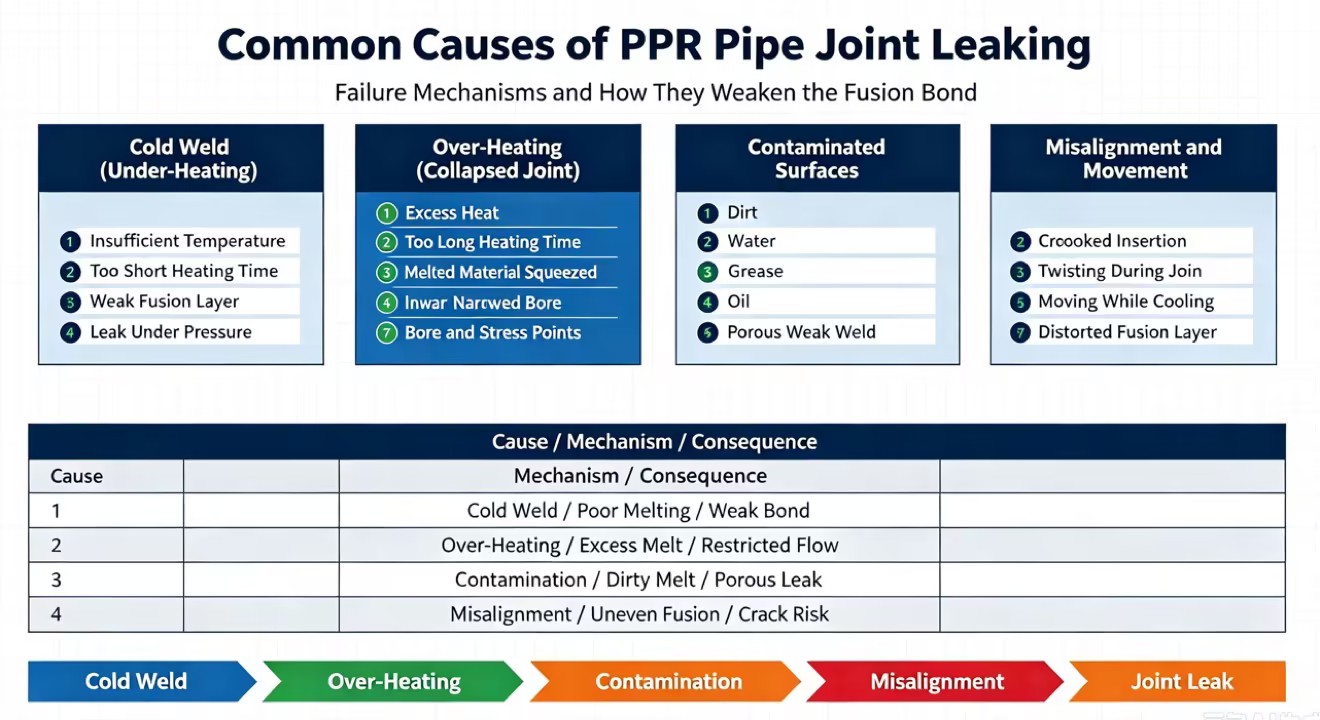
One of the most frequent causes is under-heating, also called a cold weld. If the heating iron isn’t hot enough or the pipe and fitting are on it too briefly, the surfaces don’t melt properly. Instead of fusing fully, they just stick together weakly. This joint may look fine at first but can leak under pressure or heat. To avoid this, always ensure the iron reaches the correct temperature (around 260°C), keep the heating surfaces clean, and apply the exact heating time recommended for the pipe diameter.
Over-heating (Collapsed Joint) and How It Restricts Flow
Over-heating is the opposite problem. Leaving the pipe and fitting on the iron too long melts too much material. When joined, the molten plastic squeezes inward, forming a ridge inside the pipe. This bead narrows or even blocks the flow passage, creating pressure points prone to cracking. It also weakens the joint by deforming the fitting socket. Avoid this by strictly following the maximum heating time for each pipe size. Don’t add extra seconds thinking it’s safer—more heat damages the joint.
Effect of Dirty, Wet, or Greasy Surfaces on Fusion Quality
Fusion works only when clean plastic bonds to clean plastic. Dirt, water, grease, or oil on the pipe ends or fitting sockets contaminates the melt. This contamination creates porous, weak welds that leak under pressure. On-site conditions like dust, rain, or oily hands often cause this. Always cut pipe ends square, then immediately clean and dry them before welding. Avoid touching cleaned surfaces. Never weld wet joints—work under shelter if it’s raining.
Misalignment and Movement During Cooling Causing Leaks
Proper alignment is critical. If the pipe is pushed crooked or twisted into the fitting, the melted layers don’t fuse evenly. This leaves thin spots prone to leaks. Even worse, moving or twisting the joint while it cools distorts the soft plastic, locking in stress and cracks. To prevent this, insert the pipe straight without rotation, align the fitting as you join, then hold the joint still and straight until fully cooled. Don’t disturb or apply pressure during this cooling phase.
Wrong Heating Time for Different Pipe Diameters
Each pipe diameter requires a specific heating and cooling time. Using a one-size-fits-all approach causes under-heating on large pipes and over-heating on smaller ones. This common mistake leads to the failures described above. Keep a heating time chart handy and follow it precisely. Count seconds carefully, especially for larger diameters that need longer heating and cooling.
Use of Bad Pipe or Cheap Fittings Leading to Leaks
Even perfect technique can’t fix poor materials. Pipes with oxidized or damaged surfaces, or fittings made from recycled or cheap resin, often fail to fuse properly. Warped sockets or out-of-round pipes cause poor seating and weak joints. Mixing brands can also cause mismatched dimensions, increasing leak risk. Use virgin-material pipes and fittings from reputable manufacturers, ideally matching brands for consistent fusion properties.
Tip: Always maintain a clean, dry workspace and follow exact heating times by pipe size to ensure strong, leak-free PPR joints.
How to Properly Make PPR Pipe Joints to Prevent Leaks
Creating strong, leak-free PPR pipe joints depends on following the correct procedure every time. Even small mistakes can cause weak spots that leak later. Here’s how to make PPR joints properly:
Correct Socket Fusion Process and Baseline Procedure
Socket fusion is the standard method for joining PPR pipes and fittings. Both the pipe end and the fitting socket are heated simultaneously on a fusion iron. This melts the surfaces to a controlled depth. After heating, you quickly push the pipe fully into the fitting without twisting. Hold the joint straight and still until it cools completely. This process fuses the two parts into one solid piece.
Key steps include:
Preheat the fusion iron to the correct temperature (around 260°C).
Insert the pipe and fitting onto the heating tool for the exact time specified by diameter.
Remove both from the iron simultaneously.
Push the pipe fully into the fitting socket, aligning straight without rotation.
Hold the joint still and straight during the entire cooling period.
Importance of Clean, Dry, and Square-Cut Pipe Ends
Cleanliness is critical. Dirt, water, or grease on the pipe or fitting surfaces prevents proper fusion. Always cut pipe ends square using a specialized pipe cutter. Avoid rough or angled cuts. Immediately wipe the pipe end and fitting socket clean and dry before heating. Never weld wet or contaminated surfaces.
Following Specified Heating and Cooling Times by Diameter
Each pipe diameter requires precise heating and cooling times. Larger pipes need longer heating and cooling periods. Using incorrect times causes under-heating (weak joints) or over-heating (deformed joints). Always consult the fusion time chart for your pipe size and count seconds carefully. Don’t rush cooling; the joint must solidify fully before moving or testing.
Avoiding Twisting or Moving Joints During Cooling
After joining, the PPR remains soft and vulnerable for several seconds. Twisting, pushing, or pulling the joint before it cools can distort the fusion layer, causing cracks or leaks. Hold the joint steady and straight until it feels completely firm. Do not try to adjust the fitting or pipe once joined.
Ensuring Proper Alignment and Full Insertion of Pipe into Fittings
Proper alignment ensures even fusion around the joint. Push the pipe straight into the fitting socket until it reaches full depth. Partial insertion leaves weak spots prone to leaks. Avoid crooked or angled entry; the pipe and fitting must line up perfectly. If the joint feels tight, don’t force it crooked—cut a fresh pipe end and try again.
Tip: Always prepare pipe ends carefully, follow exact fusion times by diameter, and hold joints steady during cooling to create strong, leak-proof PPR connections every time.
Maintenance Tips to Prevent PPR Pipe Leaking
Proper maintenance plays a crucial role in keeping PPR pipe joints leak-free and extending the life of the plumbing system. Even the best installation can face issues if regular upkeep is neglected. Here are essential maintenance tips to help you prevent leaks and ensure reliable performance.
Regular Inspection of PPR Connections for Early Leak Detection
Make it a habit to visually inspect all accessible PPR joints every few months. Look for signs such as:
Damp spots or water stains around joints
Discoloration or corrosion marks
Any visible cracks or deformations
Loose or misaligned fittings
Early detection lets you address small leaks before they worsen. Use a flashlight and mirror for hard-to-see areas. If you spot any abnormalities, schedule repairs immediately to avoid bigger problems.
Ensuring Proper Installation with Quality Tools and Calibrated Welders
Maintenance starts with correct installation. Using high-quality, calibrated welding equipment ensures consistent heating temperature and timing for socket fusion. Poorly calibrated irons can cause under- or over-heating, leading to weak joints. Regularly check and maintain your fusion tools to keep them in top condition. Also, use proper pipe cutters and cleaning materials to prepare pipe ends before welding.
Avoiding Excessive Pressure and Heat Stress on Joints
PPR joints withstand normal operating pressure and temperature but can fail under excessive stress. Avoid pressure surges by installing pressure regulators or water hammer arrestors in the system. Insulate hot water lines to minimize thermal stress and keep temperatures within the PPR pipe’s limits (usually below 90°C). Excessive heat or pressure accelerates joint fatigue and can cause leaks over time.
Accounting for Thermal Expansion to Reduce Joint Stress
PPR pipes expand and contract as temperatures fluctuate. Without proper allowances, this movement stresses joints and fittings. Incorporate expansion loops, flexible couplings, or sliding supports in long pipe runs. Avoid rigid fixing that prevents natural movement. Allowing for thermal expansion reduces mechanical strain and helps maintain joint integrity.
Periodic Cleaning to Prevent Deposits and Blockages
Over time, mineral deposits, dirt, or biofilm can build up inside pipes, especially in areas with hard water. These deposits increase flow resistance and pressure, putting additional strain on joints. Periodically flush the system with clean water or mild cleaning agents safe for PPR. Avoid harsh chemicals that degrade plastic. Keeping pipes clean protects joints and maintains flow efficiency.
Prompt Replacement of Damaged Fittings
Damaged or worn fittings compromise joint strength and promote leaks. Inspect fittings during maintenance checks and replace any showing:
Cracks or splits
Warping or deformation
Persistent leaks despite tightening
Always use original or certified PPR fittings from reputable manufacturers. Cheap or recycled fittings often fail prematurely, causing costly repairs.
Proper Securing of Pipes to Avoid Movement and Impact Damage
Unsecured pipes can move due to vibrations, pressure changes, or thermal expansion. This movement stresses joints and may cause leaks. Use appropriate pipe clamps or brackets spaced according to pipe diameter and application. Avoid over-tightening supports, which can pinch pipes or fittings. Also, protect exposed pipes from accidental impact by installing guards or placing them away from high-traffic areas.
Tip: Schedule routine inspections and maintenance using calibrated fusion tools, proper supports, and timely repairs to keep PPR joints leak-free and extend system life.
How to Spot and Handle Suspect PPR Pipe Joints
Knowing how to identify and manage suspect PPR pipe joints is crucial for preventing leaks and costly repairs. Faulty joints often look fine at first but fail under pressure or heat. Catching problems early saves time and money.
Visual Indicators of Bad Joints: Weld Bead Appearance and Alignment
A good PPR joint shows a small, even weld bead all around where the pipe meets the fitting. The pipe should be fully inserted, and the fitting aligned squarely. Watch for these warning signs:
No visible weld bead or a very faint bead — may mean under-heating
A heavy, uneven, or lumpy bead — often caused by over-heating
Pipe not inserted fully into the fitting socket
Crooked or misaligned fittings
Scorch marks or discoloration on the joint area
Any of these suggest the joint may be weak or compromised.
Signs of Under-Heated and Over-Heated Joints
Under-heated joints, or cold welds, have poor fusion. They might look smooth but lack strength. They often leak after pressurizing or heating. Over-heated joints show a thick bead inside the pipe, narrowing the bore. This restricts flow and stresses the joint, risking cracks.
Why Suspect Joints Must Be Cut Out and Redone
Suspect joints cannot be repaired in place. Using sealants or clamps only masks the problem temporarily. The only reliable fix is cutting out the faulty section and fusing a new joint properly. Burying a bad joint guarantees future leaks and callbacks.
Pressure Testing Protocols Before Wall Closure
Always pressure test the PPR system before closing walls or ceilings. Testing detects leaks early when repairs are easier. Follow recommended cooling times by pipe diameter before pressurizing. Test the entire system at working pressure, not just individual joints.
Risks of Burying Faulty Joints and Ignoring Leaks
Ignoring leaks or burying suspect joints leads to costly damage later. Water leaks cause mold, structural damage, and increased water bills. Once concealed, repairs require opening walls, raising labor and material costs. Early detection and correction prevent these headaches.
Tip: Always inspect weld beads closely and pressure test before closing walls; cut out and redo any suspect joints to ensure a leak-free PPR system.
Frequently Asked Questions About PPR Pipe Leaking
Why does my PPR joint leak after initially passing inspection?
This usually happens because of a cold weld, meaning the joint was under-heated during fusion. The pipe and fitting might have stuck together but didn’t fully melt and fuse. At low pressure or room temperature, it seems fine, but once the system is pressurized or heated, the weak joint leaks. Unfortunately, these leaks can't be fixed by patching or sealants. The only reliable solution is cutting out the faulty joint and redoing the fusion with the correct heating temperature and time.
Can leaking PPR fusion joints be repaired in place?
No, leaking fusion joints cannot be repaired on-site. PPR fusion creates a permanent bond by melting the pipe and fitting surfaces together. If a joint leaks, it means the fusion failed. Temporary fixes like clamps or sealants only mask the problem and risk bigger failures later. The proper fix is to cut out the defective section and fuse a new joint using the correct process. This is why pressure testing before closing walls is so important — it catches leaks early when repairs are easier.
How long should PPR joints cool before pressure testing?
Cooling time depends on pipe diameter. Larger pipes take longer to cool fully and solidify. Rushing the cooling phase risks joint distortion or weak fusion. Follow the manufacturer’s fusion time chart strictly for heating and cooling times. Typically, joints need several minutes to cool before pressurizing. Testing too soon can cause leaks or joint failure. Also, allow the entire system to rest and cool before a full pressure test rather than testing joints individually while still warm.
Does the fitting brand affect leak potential?
Yes, fitting brand matters a lot. Cheap or recycled-resin fittings often have inconsistent dimensions or poor material quality, leading to weak fusions and leaks. Mixing different brands can cause mismatched socket sizes, preventing proper seating and fusion. Using virgin-material fittings from reputable manufacturers, ideally matching the pipe brand, ensures consistent dimensions and fusion properties. This reduces leak risk and improves joint reliability.
What to do if leaks persist despite proper installation?
If leaks continue after following all installation guidelines, consider these steps:
Double-check the fusion iron’s temperature and calibration. An inaccurate iron can cause under- or over-heating.
Inspect pipe and fitting quality. Even small surface damage or contamination can cause leaks.
Verify that heating and cooling times match the pipe diameter exactly.
Ensure no movement or twisting occurred during cooling.
If all else fails, consult with the manufacturer or a professional installer for troubleshooting. Persistent leaks may indicate hidden defects or improper materials.
Tip: Always perform pressure testing after full joint cooling and before wall closure to catch leaks early and avoid costly repairs.
Choosing Quality Materials to Minimize PPR Pipe Leaking
Selecting the right materials is key to preventing leaks in PPR pipe joints. Even the best installation techniques can’t fix poor-quality pipes or fittings. Here’s why quality matters and what to look for.
Importance of Using Virgin-Material Fittings and Pipes
Virgin-material PPR pipes and fittings are made from pure polypropylene resin, free from recycled plastics or contaminants. This purity ensures consistent melting behavior during fusion, creating strong, homogenous joints. Virgin materials resist cracking, warping, and degradation better over time. Using them reduces the chance of weak welds that leak under pressure or heat.
Avoiding Recycled-Resin and Cheap Fittings
Cheap fittings often contain recycled resin or fillers to cut costs. These materials don’t melt evenly or bond well during fusion. The result is porous, brittle joints prone to failure. Recycled-resin fittings may also have inconsistent dimensions or warped sockets, causing poor pipe seating and weak fusion. Avoid these fittings to save on costly repairs and callbacks.
Matching Pipe and Fitting Brands for Consistent Fusion
Different brands may use slightly different formulations or manufacturing tolerances. Mismatched pipes and fittings can lead to socket dimensions that don’t fit perfectly. This mismatch causes uneven fusion layers and weak spots. For best results, use pipes and fittings from the same trusted brand. This ensures compatibility and consistent fusion quality.
Certifications and Standards to Look for in PPR Products
Choose PPR products certified to recognized standards such as:
ISO 15874 — International standard for PPR piping systems
DIN 8077/8078 — German standards for pipe dimensions and quality
EN 15874 — European standard for hot and cold water PPR systems
ASTM F2389 — American standard for pressure-rated PPR pipes
Certified products undergo rigorous testing for material quality, dimensional accuracy, and performance. They provide assurance of durability and leak resistance.
Tip: Always specify virgin-material pipes and fittings from reputable, certified brands matched for your project to ensure strong, leak-free PPR joints.
Conclusion
PPR pipe joints often leak due to under-heating, over-heating, misalignment, or poor materials. Proper installation and maintenance are essential to avoid these issues. Always follow precise heating times, use clean pipe ends, and hold joints steady during cooling. Prioritizing high-quality pipes and fittings and conducting pressure tests ensures reliable, leak-free systems. For durable and efficient PPR piping solutions, trust the expertise and superior products offered by [www.akanpolygon.com POLYGON]. Their commitment to quality supports long-lasting plumbing installations.
FAQ
Q: What causes PPR pipe leaking at joints?
A: PPR pipe leaking typically occurs at joints due to under-heating (cold weld), over-heating, dirty surfaces, misalignment, or poor-quality fittings, all of which weaken the fusion and cause leaks.
Q: How can I prevent PPR pipe leaking during installation?
A: Prevent PPR pipe leaking by ensuring correct heating temperature and time, clean and dry pipe ends, proper alignment, and using quality virgin-material fittings matched to the pipe brand.
Q: Can I repair a leaking PPR pipe joint without replacing it?
A: No, leaking PPR pipe joints cannot be repaired in place. The faulty section must be cut out and re-fused properly to stop leaks.
Q: Does the brand of fittings affect PPR pipe leaking?
A: Yes, using cheap or mismatched fittings increases PPR pipe leaking risk. Always choose certified, virgin-material fittings from reputable brands matching your pipes.
Q: How long should I wait before pressure testing to avoid PPR pipe leaking?
A: Cooling time varies by pipe diameter; always follow manufacturer guidelines to wait several minutes before pressure testing to ensure joints have fully solidified and prevent leaks.
Related Articles
CONTACT
Get in Touch With Us