
Most buyers start with a simple assumption: "PPR is PPR." Then they walk into a distributor's showroom and face four options on the shelf — Standard PPR, PPR Fiber Pipe, PPRCT, and PPR Aluminum. The price gap can be twofold, yet all claim to be "upgraded." So which one actually earns its premium?
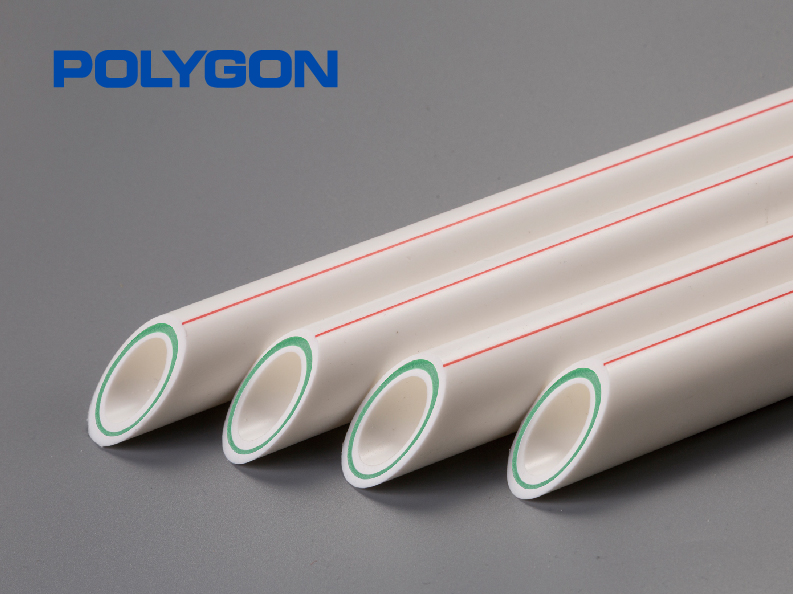
PPR Fiber Pipe solves a very specific headache: thermal expansion. Built with a three-layer co-extrusion, it sandwiches a glass-fiber reinforced layer between inner and outer layers of virgin PP-R. That middle layer cuts the linear expansion coefficient to roughly 20–30% of standard PPR — about 0.03–0.05 mm/(m·K) — while pushing the long-term operating temperature to 95°C and raising pressure capability above PN16. Because the outer layer is still PP-R, it connects with standard heat-fusion fittings. No stripping, no special tools.
Where does that matter? In long exposed hot-water runs, high-rise risers, underfloor heating manifolds, and solar loops — anywhere a standard PPR line would develop an unsightly "snake" bend as it heats and cools. PPR Fiber Pipe holds its shape, needs fewer support clamps, and keeps the installation workflow unchanged.
PPR Fiber Pipe vs. Standard PPR
Parameter | Standard PPR | PPR Fiber Pipe |
Linear expansion | ~0.15 mm/(m·K) | ~0.03–0.05 mm/(m·K) |
Rigidity | Moderate | High – no sagging |
Pressure rating | PN16 | Above PN16 |
Installation | Socket fusion | Socket fusion (same) |
Cost | Lowest | Moderate |
Best for | Short concealed lines | Long runs, high-rise risers |
The comparison here is straightforward. Standard PPR remains the cost-efficient choice for short, concealed apartment lines where expansion never becomes visible. PPR Fiber Pipe justifies its higher price only when the run is long, the pipe is exposed, or thermal movement would otherwise force you to add expansion loops. In practice, many contractors keep a roll of standard PPR for quick repairs and switch to Fiber Pipe for the main risers.
PPR Fiber Pipe vs. PPR Aluminum Pipe
Factor | PPR Aluminum Pipe | |
Reinforcement | Glass-fiber core | Aluminum foil core |
Linear expansion | 0.03–0.05 mm/(m·K) | ~0.02–0.03 mm/(m·K) |
Oxygen barrier | Limited | Excellent (near 100%) |
Fusion prep | None – direct socket fusion | Must strip aluminum layer |
Installation speed | Faster | Slower |
Cost | Moderate | Higher |
Best for | Water supply networks | Closed-loop heating |
This is where the trade-off gets real. The aluminum composite variant drives expansion even lower and provides a genuine oxygen barrier — that's why it dominates closed-loop radiator heating. But every single joint requires stripping the aluminum and outer PP-R layer before welding. On a hotel project with 300 joints, that adds a full day of labor. PPR Fiber Pipe trades away the absolute lowest expansion and the oxygen barrier, but keeps the simple direct fusion and faster installation. For a hotel, hospital, or apartment block where hundreds of joints are made in a week, that difference is felt directly in the labor bill.
PPR Fiber Pipe vs. PPRCT Pipe
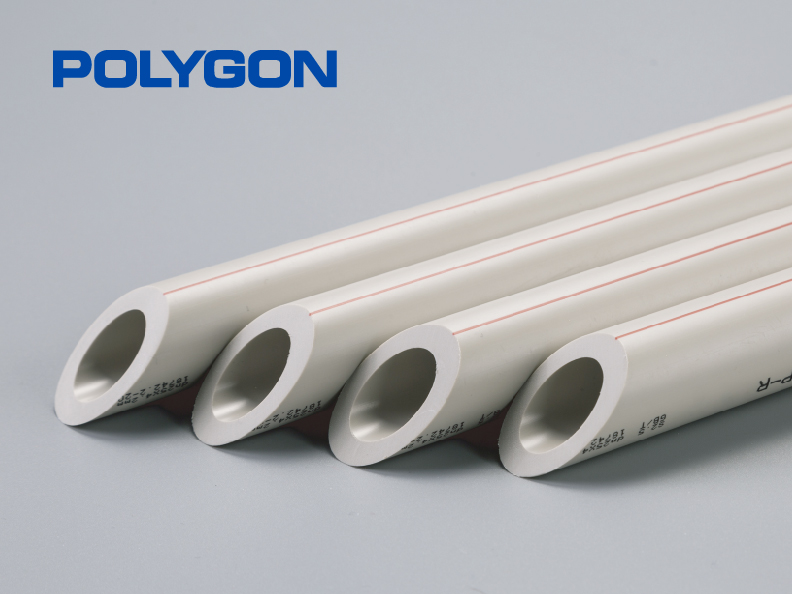
PPRCT answers a different question entirely. Defined under DIN 8077-2007 and DIN 8078-2007 as Type 4 Polypropylene with a hexagonal β-crystalline structure, it is a material-level upgrade. By shifting the crystal form from α to β, it reaches a stable 50-year service life at 90°C and 1.0 MPa — 20°C higher than standard PP-R — with a pressure class 1–2 S-levels above PP-R and walls 15–20% thinner.
Factor | PPR Fiber Pipe | PPRCT Pipe |
Core technology | Glass-fiber reinforced core | Hexagonal β-crystalline PP-R |
Max continuous temp. | 95°C | 90°C (at 1.0 MPa, 50 years) |
Pressure class vs. PP-R | Above PN16 | 1–2 S-levels higher |
Wall thickness | Standard | 15–20% thinner possible |
Primary improvement | Dimensional stability & easy install | High-temp & high-pressure capacity |
Best for | Long runs, high-rise risers | High-temperature heating facilities |
PPRCT is built for high-temperature heating pipes. PPR Fiber Pipe, by contrast, is not chasing temperature records; it is chasing dimensional stability and installability. In a northern high-rise, the sensible combination is often PPRCT for the high-temperature heating circuit and PPR Fiber Pipe for the cold/hot water risers.
When to Choose PPR Fiber Pipe
Based on POLYGON's product positioning and field experience, PPR Fiber Pipe is the recommended choice for:
1. Large-area villa long-distance whole-house piping
2. Commercial building centralized hot/cold water supply
3. Medium/small engineering long-distance water supply projects
4. High-temperature water delivery requiring anti-deformation performance
5. High-rise building risers (where standard PPR would sag or expand excessively)
6. Underfloor heating manifolds (not the underfloor loops themselves)
It sits in the sweet spot: a measurable upgrade over standard PPR, without the installation penalty of aluminum composite or the temperature-focused engineering of PPRCT.
POLYGON's PPR Product Matrix
POLYGON offers the complete PPR family, all manufactured with premium raw materials from Borealis and Korean Hyosung, all sharing a 50-year design life:
● Standard PPR Pipe – Cost-effective all-rounder for concealed plumbing
● PPR Fiber Pipe – Anti-deformation solution for long runs and high-rise risers
● PPRCT Pipe – Type 4 Polypropylene (DIN 8077/8078) for high-temperature heating
● PPR Aluminum Pipe – Premium oxygen-barrier solution for exposed and heating applications
Final Recommendation
The buying logic is less "which is best" and more "which problem do I have":
● Choose PPR Fiber Pipe when runs are long, thermal expansion is a concern, installation speed matters, and the system is a water supply network.
● Choose PPR Aluminum Pipe when a true oxygen barrier is needed (closed-loop heating) and you can accommodate the extra stripping step.
● Choose PPRCT when the project involves high-temperature heating (>70°C continuous) or requires 1–2 S-levels higher pressure.
● Choose Standard PPR when budget is primary and runs are short and concealed.
By matching the pipe variant to your project's specific demands, you maximize both performance and cost-effectiveness — exactly what POLYGON's full-series PPR product matrix is designed to deliver.
Related Articles

Polygon to Showcase Piping & Ventilation Systems at Aquatherm Almaty 2026
Polygon to Showcase Piping & Ventilation Systems at Aquatherm Almaty 2026 The 18th edition of Aquatherm Almaty 2026 – the leading international exhibition for heating, water supply, sanitary, air-conditioning and ventilation equipment in Central Asia – will take place from September 2 to 4, 2026 at

PPR Pipes in Home Renovation: Which Type Suits Your Project?
IntroductionWhen planning a home renovation, the plumbing system is one of the most critical yet often overlooked elements. Once the walls are sealed and the floors laid, accessing pipes for repair becomes expensive and disruptive. Choosing the right pipe material is therefore a decision that affect

How PPR Pipes are Classified?
Introduction PPR pipe, short for Polypropylene Random Copolymer pipe, is manufactured with polypropylene random copolymer as the core raw material. It belongs to thermoplastic plastic pipelines specially developed for cold and hot water transportation. As one of the most mainstream water supply pipe

Akan Enterprise Group and Xinjiang Zhongtai Chemical Co., Ltd. Sign Strategic Cooperation Agreement to Jointly Build a New Landscape of Industry Chain Collaborative Innovation
On July 9, 2026, Akan Enterprise Group (Zhejiang) Co., Ltd. and Xinjiang Zhongtai Chemical Co., Ltd. officially signed a strategic cooperation agreement in Urumqi, Xinjiang. Lin Wangzhu, President of Akan Enterprise Group, and Huang Xiaohu, Member of the Party Committee and Deputy General Manager of
CONTACT
Get in Touch With Us