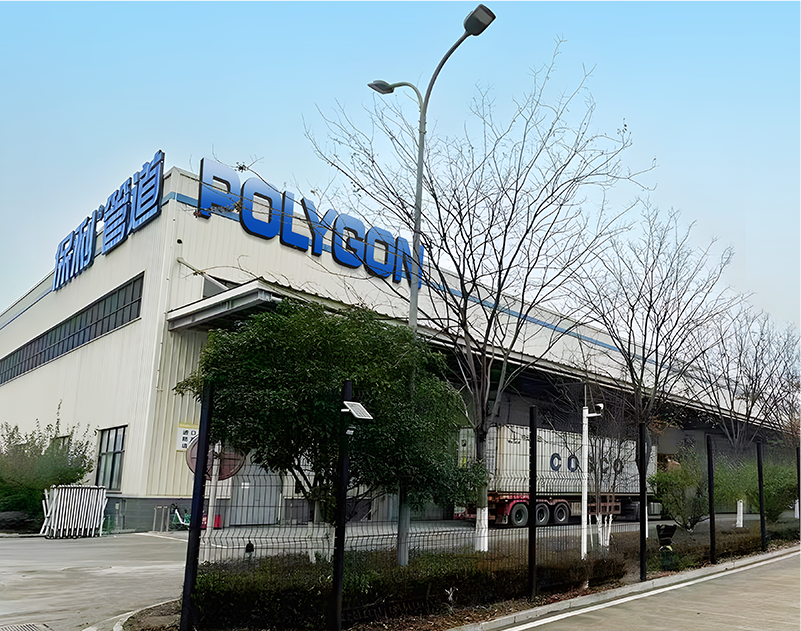

The production of Polygon PVC Piping System components is a precise thermoplastic process where pipes and fittings use different molding techniques but share rigorous quality controls. The entire process can be summarized as a standardized closed-loop of: "Mixing - Forming - Post-Processing - Quality Inspection."
Phase 1: Material Foundation
This is the starting point for all PVC product manufacturing, determining the "genetic" quality of the product.
● Precise Engineering Formulation: Components are formulated for specific applications (water supply, drainage, electrical) using precisely measured PVC resin, calcium-zinc stabilizers, and functional additives.
● Advanced Material Processing: Through high-speed hot mixing (100-120°C) and controlled cooling (40-50°C), we create uniform dry-blend powder that ensures consistent processing and performance across the complete PVC Piping System.

Phase 2: Pipe Manufacturing: Continuous Precision Extrusion
Pipe production focuses on creating the consistent, reliable conduits that form the backbone of any PVC Piping System.
● Precision Extrusion: Material is fed into twin-screw extruders with precise temperature control (160-190°C gradient), ensuring optimal plasticization for uniform pipe quality.
● Advanced Sizing Technology: Through vacuum sizing and spray cooling systems, pipes achieve exact dimensional accuracy and minimal residual stress - critical for long-term system reliability.
● Automated Processing: Computer-controlled haul-off and cutting systems maintain consistent production quality, with optional end-belling for socket-type connections.

Phase 3: Fitting Manufacturing: Precision Injection Molding
Fitting production requires different technology to create the complex components that ensure system integrity.
● High-Precision Molding: Using injection pressures of 80-150 MPa, molten material completely fills precision mold cavities, creating fittings with consistent wall thickness and structural integrity.
● Controlled Cooling Process: Scientific cooling protocols prevent deformation and ensure dimensional stability across all fitting components.
● Automated Finishing: Robotic systems handle degating, trimming, and secondary operations, maintaining the high quality standards required for leak-free connections.

Phase 4: Quality Assurance
Every component undergoes rigorous testing to ensure the complete PVC Piping System meets performance expectations.
● Comprehensive Testing Protocol: Multiple test categories including dimensional verification, pressure testing, impact resistance, and for water applications, hygienic certification.
● Traceability and Packaging: Each batch receives permanent identification for complete traceability, with protective packaging ensuring components arrive in perfect condition.
In summary, the production of Polygon PVC pipes and fittings is a perfect integration of formulation science, process control, and equipment precision. The core of pipe technology lies in stable continuous extrusion, while the core of fitting technology lies in precise mold forming. From a pile of raw material powder to sturdy, durable pipes and structurally precise fittings, each step embodies the relentless pursuit of precision, efficiency, and quality in Polygon manufacturing.
Related Articles

Impact of PVC Raw Materials on PVC Pipe Products: A Key to System Performance
The performance, durability, and application suitability of a PVC piping system are fundamentally determined by the precise selection and scientific formulation of its raw materials. For engineers, specifiers, and contractors, understanding this core relationship is key to selecting products that deliver long-term reliability. This analysis breaks down how each raw material component shapes the final product within a high-performance PVC pipe network.

What Are PPR Fittings And How Do They Work?
Introduction A small leak can damage walls and budgets. Traditional threaded or glued joints may loosen over time. Modern buildings demand stronger, safer systems. That is why PPR Fittings are gaining attention worldwide. They create a seamless, heat-fused pipeline without glue or rubber seals.

Why PPR Fittings Are Widely Used in Modern Plumbing
Introduction Modern plumbing has evolved beyond metal pipes that rust and leak over time. Builders now demand systems that last longer and require less maintenance. This shift explains why PPR Fittings are widely used in modern plumbing today.
CONTACT
Get in Touch With Us