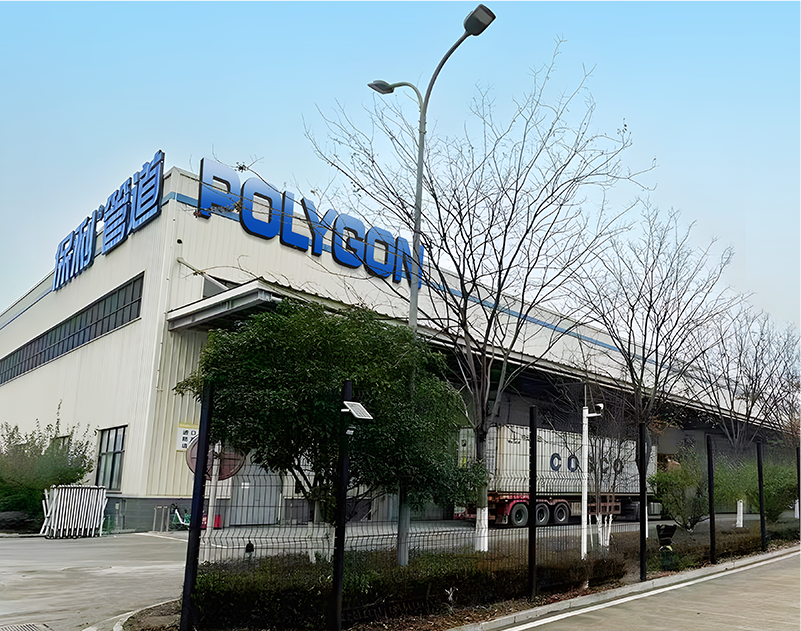

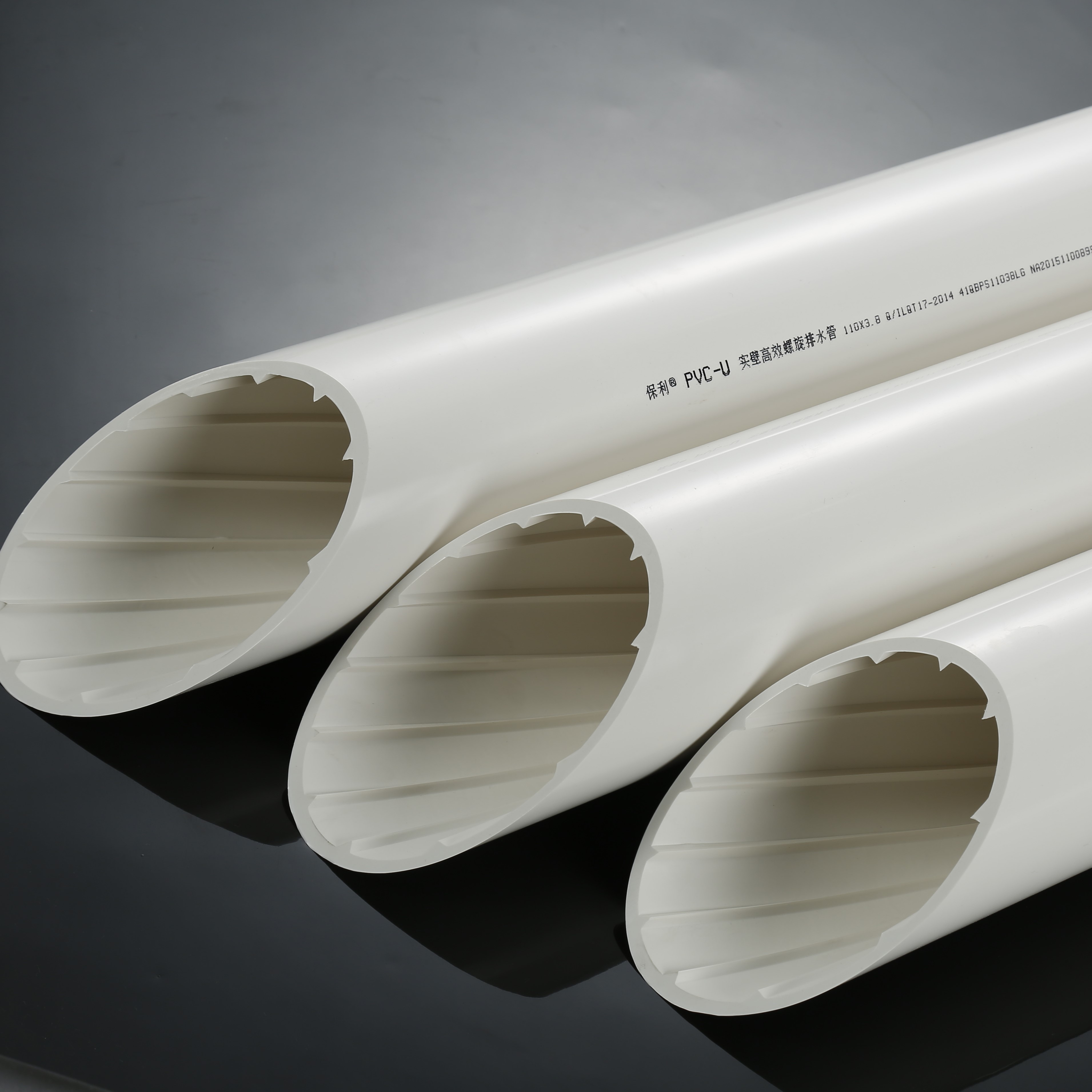
PVC Structured Wall Pipes are not traditional solid thick-walled pipes. They are "lightweight, high-strength" pipes that enhance mechanical performance by optimizing the cross-sectional geometry (e.g., corrugation, hollow walls, ribbed structures). This perfectly embodies the engineering philosophy of "using material where it counts the most." They are primarily categorized into three types: UPVC Structured Wall Pipe, UPVC Solid Wall Spiral Pipe, and UPVC Hollow Spiral Pipe, widely used in building drainage and municipal buried applications.
I. Structural Principle: The Mechanical Wisdom of "Form Over Mass"
Unlike solid wall pipes that simply increase wall thickness, structured wall pipes utilize the principle of the second moment of area (area moment of inertia). They distribute material away from the neutral axis (e.g., outer wall corrugations, hollow cores, external ribs). This design significantly reduces material usage (by approximately 30%) while markedly improving the pipe's ring stiffness (resistance to external pressure). It achieves a balance of "lightweight and high strength," offering a modern solution to replace concrete and cast iron pipes.
II. Core Performance Characteristics
1. High Stiffness and Pressure Resistance
Through double-wall corrugation or ribbed structures, the pipe's section modulus increases significantly. Even with relatively thin walls, it can achieve ring stiffness classes of SN4, SN8, SN12.5, or even higher. This enables it to effectively withstand soil pressure and dynamic surface loads after burial, resisting deformation or crushing.
2. Excellent Hydraulic Characteristics
The interior wall is extremely smooth (Manning's coefficient n ≈ 0.009), far superior to concrete pipes (n ≈ 0.013). Flow capacity can increase by approximately 30% to 40% for the same diameter, or a smaller pipe diameter can be selected for the same flow rate, effectively reducing excavation costs and slope requirements.
3. Superior Corrosion Resistance
Inheriting the chemical inertness of PVC material, it offers strong resistance to acids, alkalis, salts in soil, and chemicals in domestic sewage. No anti-corrosion treatment is needed, unlike metal pipes. Its service life under normal conditions can exceed 50 years, far surpassing concrete and cast iron pipes.
4. Significant Noise Reduction (For Building Drainage)
Hollow wall/spiral structured wall pipes used inside buildings utilize the hollow layer for sound insulation and internal spiral ribs to guide flow. This effectively disrupts the air column noise generated by water flowing along the wall. The noise reduction effect is 5-10 dB better than solid wall pipes, making them particularly suitable for residential building stacks where quiet operation is required.
5. Lightweight and Easy Installation
Weight is only 1/10 to 1/5 that of concrete pipes of the same specification, and they come in longer lengths (typically 6 meters per piece). Using push-fit rubber ring joints, installation requires no heavy machinery—just manual labor or simple tools. This greatly improves installation efficiency. The joints also offer a degree of flexibility, accommodating minor ground settlement.
6. Economic and Environmental Benefits
Due to material savings and lower transportation/installation costs, the overall cost is typically lower than traditional pipe materials. Furthermore, PVC is recyclable, and the smooth inner wall resists scaling, reducing maintenance costs and environmental pollution risks.
III. Main Types and Application Scenario Comparison
Product Type | Core Structure & Design Features | Key Performance Advantages | Typical Application Scenarios |
PVC-U Standard Solid Wall Spiral Sound-Attenuating Pipe | Solid wall pipe with spiral flow guide ribs on the inner wall. | 1. Basic Noise Reduction: Spiral structure guides water flow, reducing liquid-gas impact noise. 2. Smooth Drainage: Smooth inner wall with guide ribs enhances flow efficiency. | Drainage stacks in mid-to-high-rise residential buildings, offices, schools, etc., where general noise reduction is required. |
Inner and outer walls connected by ribs forming a hollow cavity; inner wall has a spiral structure. | 1. Excellent Sound Insulation: Hollow cavity effectively blocks and absorbs sound waves, offering significant noise reduction. 2. Thermal Insulation: Hollow structure provides some thermal insulation. 3. Lightweight & High Strength. | Drainage systems in high-rise/super high-rise residential buildings, hotels, hospital wards, luxury apartments with stringent noise requirements. | |
PVC-U Double-Wall Hollow Pipe (Smooth Wall) | Smooth inner wall, outer wall is thickened solid or micro-foamed layer, with a hollow structure in between. | 1. High Ring Stiffness: Excellent resistance to external pressure, suitable for buried applications. 2. Superior Chemical Corrosion Resistance. 3. Good Hydraulic Performance: Smooth inner wall, resistant to scaling. | Underground drainage networks in building complexes, outdoor buried sewage pipes, siphonic rainwater systems. |
PVC-U Reinforced Solid Wall Spiral Drainage Pipe (Special Single Stack System) | Uses high-strength solid wall with special spiral structure, often paired with dedicated swirl fittings. | 1. Ultra-High Drainage Load Capacity: Meets instantaneous high-flow drainage demands of tall buildings. 2. Strong System Stability: Effectively prevents water seal breakage, reduces drainage air pressure fluctuations. 3. Extreme Quietness. | Core drainage stacks in super high-rise buildings, large commercial complexes, public buildings, replacing traditional dual-stack systems. |
IV. Key Points for Selection and Installation
● Selection Basis: For buried pipes, sufficient ring stiffness (SN value) must be selected based on burial depth and ground load. Using thinner-walled pipes to cut costs is strictly prohibited.
● Foundation Requirements: Although foundation requirements are lower than for concrete pipes, a sand bedding layer must still be laid and proper backfill compaction performed to utilize the "pipe-soil interaction" and leverage its flexible advantages.
V. Summary
The Polygon PVC-U Structured Wall Drainage Piping System, through "structural innovation", precisely addresses the core challenges in building drainage, especially in high-rise buildings: high flow rates, high noise levels, and high water pressure. Its product matrix is rich, offering targeted solutions from standard noise reduction to extreme quietness, and from indoor stacks to buried networks. It is a modern, high-performance drainage system combining high strength, corrosion resistance, high efficiency, and quiet operation, particularly well-suited for drainage scenarios in high-rise and super high-rise buildings.
Related Articles

How to install UPVC electrical pipes?
The construction quality of UPVC drain pipes directly determines the flow capacity, sound attenuation, and long-term sealing performance of the drainage system. The core of its process lies in utilizing solvent-weld socket (indoor) and rubber ring flexible (outdoor/buried) connections to build a sta

What are the application scenarios of UPVC Drainage Pipes?
UPVC drain pipes, with their comprehensive advantages of corrosion resistance, smooth inner walls, lightweight for easy installation, and good economy, have become the material of choice for modern building drainage systems. Their application spans the entire building lifecycle, covering civil, indu

What is UPVC Drain Pipe Fittings?
The fittings (pipe joints) in a UPVC drainage system are the functional hubs strictly matched with the pipes. Their design directly determines the pipeline routing, branching logic, and sealing performance. According to the GB/T 5836.2-2018 standard, these fittings are primarily produced by injectio

What is the classification of system for UPVC drainage pipes?
The classification of UPVC drainage pipes is primarily centered around their application scenarios and structural performance, aimed at matching different engineering requirements through standardized specifications and models. The classification logic is clear, with divisions mainly based on wall s

What are the applications of PVC Electrical Conduit ?
PVC electrical conduit (also known as "Insulated Electrical Conduit for Buildings"), with its combined advantages of insulation and flame retardancy, pressure and corrosion resistance, lightweight and easy installation, has become a core foundational material for modern building electrical wiring. I
CONTACT
Get in Touch With Us