
Choosing the wrong PPR pipe size can cause leaks and poor water flow. Did you know many plumbing issues start with incorrect pipe sizing? PPR pipes are popular for their durability and safety in plumbing systems.
In this post, you’ll learn why selecting the right PPR pipe size matters. We’ll explain key terms like DN, OD, and PN to help you make informed decisions. Understanding these basics ensures your plumbing system runs efficiently and lasts longer.
Table of Contents
Understanding PPR Pipe Sizes and Specifications
Metric Outer Diameter (OD) and Nominal Diameter (DN)
PPR pipes are usually identified by their outer diameter (OD) measured in millimeters. This is the actual size across the pipe’s outside edge. However, the industry also uses Nominal Diameter (DN), which is a standardized reference number. DN doesn’t exactly equal the OD but helps engineers and installers communicate pipe sizes easily.
For example, a pipe marked as DN20 typically has an outer diameter of 25mm. The DN number is more of a naming convention than a precise measurement. It’s essential to know both OD and DN when selecting pipes because fittings and welding tools rely on the OD, while system designs often use DN.
Pressure Ratings (PN) and Their Impact on Pipe Wall Thickness
The pressure rating (PN) tells us how much pressure a pipe can safely handle over its expected lifetime, usually 50 years at 20°C. Common PN values for PPR pipes include PN10, PN16, PN20, and PN25. Higher PN means the pipe can withstand higher pressure but usually has thicker walls.
For the same outer diameter, a PN25 pipe will have a thicker wall than a PN10 pipe. Thicker walls reduce the pipe’s inner diameter slightly, which affects flow capacity. So, when choosing pipe sizes, it’s crucial to balance pressure needs and flow requirements.
S Series and SDR Values: What They Mean for PPR Pipes
PPR pipes use S series and Standard Dimension Ratio (SDR) to express wall thickness. The S series is a classification where a lower number means a thicker wall.
The relationship between SDR and S series is:
SDR = 2 × S + 1S5 corresponds to SDR11 and usually matches PN10.
S3.2 corresponds to SDR7.4 and usually matches PN16.
S2.5 corresponds to SDR6 and usually matches PN20.
A lower SDR means a thicker wall and higher pressure resistance.
Standard PPR Pipe Sizes from 20mm to 160mm
PPR pipes come in a range of sizes, typically from 20mm up to 160mm OD for common plumbing applications. Here’s a quick overview of typical sizes and their uses:
Outer Diameter (mm) | Nominal Diameter (DN) | Common Use |
|---|---|---|
20 | DN15 | Small fixtures, cold water |
25 | DN20 | Main supply lines |
32 | DN25 | Larger homes, higher flow |
50 | DN40 | Commercial systems |
110 | DN90 | Industrial or high flow |
160 | DN125 | Large-scale distribution |
Sizes between 20mm and 50mm are most common in residential plumbing. Larger sizes like 110mm and 160mm serve commercial or industrial needs.
Note: Always verify pipe wall thickness and pressure rating when selecting pipes of the same outer diameter to ensure proper pressure handling and flow capacity for your system.
PPR Pipe Industry Standards and Compliance
International Standards Governing PPR Pipe Sizes (ISO 15874, DIN 8077, DIN 8078)
PPR pipes follow strict international standards to ensure safety, reliability, and compatibility across plumbing systems worldwide. The most recognized standards include:
ISO 15874: This global standard defines requirements for PPR piping systems used in hot and cold water installations. It covers dimensions, materials, testing, and performance criteria.
DIN 8077 and DIN 8078: German standards that specify dimensions and mechanical properties for PPR pipes. DIN 8077 relates to pipes for pressure applications, while DIN 8078 covers pipes for non-pressure uses.
These standards guarantee that pipes from different manufacturers maintain consistent sizes and pressure ratings. This consistency simplifies installation and ensures that fittings and welding tools match perfectly.
Standard Dimension Ratio (SDR) and Its Role in Pressure Capacity
The Standard Dimension Ratio (SDR) is a key concept in PPR pipe design. It’s the ratio of a pipe’s outer diameter to its wall thickness:
SDR = Outer Diameter / Wall ThicknessA lower SDR means a thicker wall relative to the diameter, which results in higher pressure resistance. Conversely, a higher SDR means a thinner wall and lower pressure capacity.
For example:
SDR Value | Typical PN Rating | Wall Thickness | Application |
|---|---|---|---|
SDR 11 | PN10 | Thinner | Cold water systems |
SDR 7.4 | PN16 | Medium | Hot/cold water systems |
SDR 6 | PN20 | Thicker | High-pressure systems |
Manufacturers design pipes to meet specific SDR values to handle designated pressure classes safely over a 50-year lifespan at 20°C. This ratio directly impacts the pipe’s durability and service life.
Ensuring Safety and Longevity Through Compliance
Compliance with these standards is vital for safety and long-term performance. Pipes built to ISO 15874 or DIN specifications undergo rigorous testing, including:
Pressure testing: Pipes are tested at pressures above their rated PN to ensure they withstand operational stresses.
Thermal stability tests: Pipes are exposed to elevated temperatures to confirm they maintain strength and integrity.
Material quality checks: Raw materials must meet strict purity and performance criteria.
Using compliant PPR pipes ensures:
Consistent quality: Avoids weak points or defects that cause leaks or failures.
Interchangeability: Pipes and fittings from different certified manufacturers fit together seamlessly.
Regulatory approval: Meets local building codes and plumbing regulations.
Non-compliant pipes risk premature failure, leaks, and costly repairs. For critical systems, choosing pipes certified to international standards is a must.
Tip: Always verify PPR pipes come with certification documents proving compliance to ISO 15874 or DIN standards before purchase to guarantee safety and performance in your plumbing projects.
How to Choose the Right PPR Pipe Size for Your Plumbing System
Starting with the Main Supply Line: Sizing Based on Peak Demand
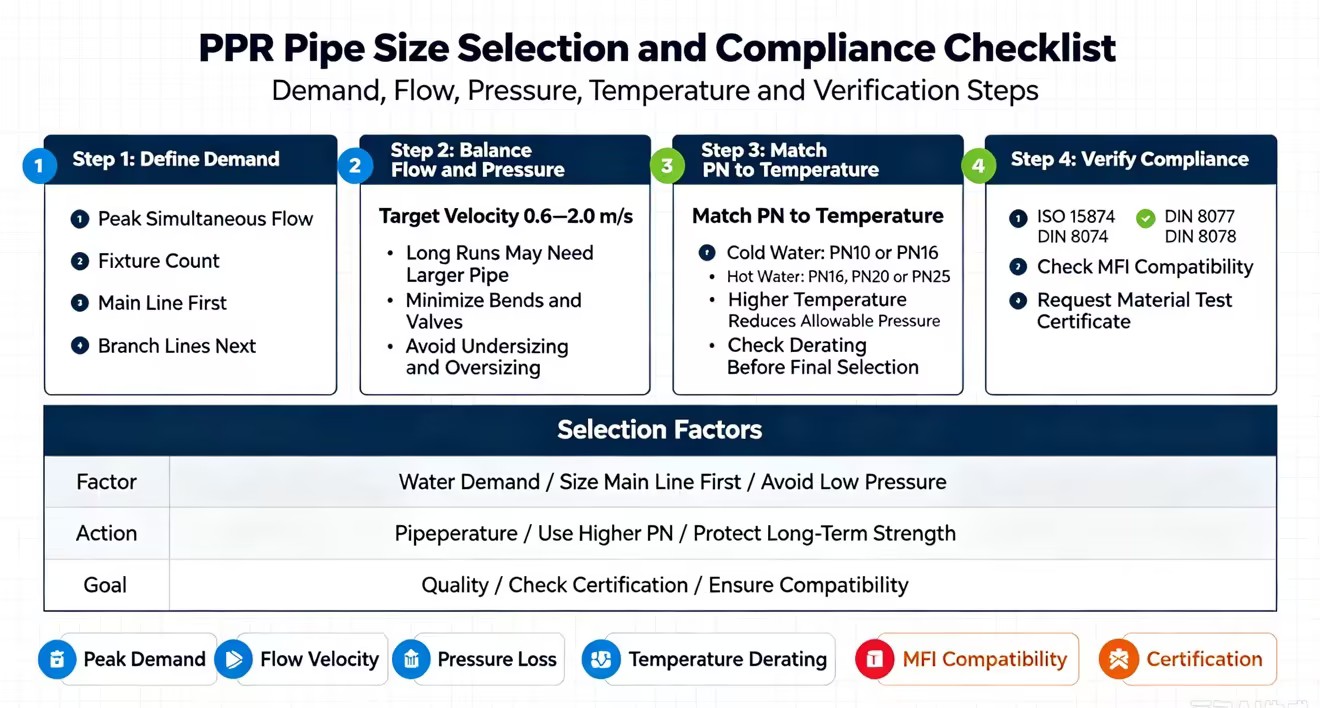
Begin pipe sizing by focusing on the main supply line. This pipe carries water from the source to all branches, so it must handle the system’s peak demand. For residential buildings, a 25mm or 32mm pipe often suffices. Larger homes or small commercial setups may require 40mm or more.
Sizing based on peak demand means estimating the maximum simultaneous water use. Undersizing this line leads to pressure drops and poor flow at fixtures. Oversizing wastes material and money. Always pick a size that balances capacity and cost.
Selecting Branch Line Sizes According to Fixture Requirements
After the main line, size branch pipes that feed individual rooms or fixture groups. Branch lines are smaller since they serve fewer outlets. For example, a kitchen or bathroom might use 20mm or 25mm pipes.
Consider fixture types and quantities. A single sink needs less flow than a group of showers. Branch pipe sizes should ensure each fixture gets enough water without pressure loss. Gradually reduce pipe diameter from main line to branches and finally to fixture connections.
Balancing Flow Rate, Velocity, and Pressure Loss
Proper sizing balances flow rate, velocity, and pressure loss. Flow rate depends on how many fixtures run simultaneously. Velocity affects noise and pipe wear; too high causes banging and erosion, too low causes stagnation.
Aim for flow velocities between 0.6 and 2.0 m/s in cold water lines. Hot water systems may tolerate slightly different values. Pressure loss grows with pipe length and fittings. Longer runs or many bends require larger pipes to maintain pressure.
Balancing these factors keeps water delivery smooth, quiet, and efficient.
Coordinating Pipe Size with Pressure Rating (PN)
Pipe size and pressure rating (PN) must match system demands. PN indicates pipe wall thickness and pressure capacity. Higher PN pipes have thicker walls but smaller inner diameters, slightly reducing flow.
For example, a 25mm PN20 pipe withstands more pressure than a 25mm PN10 pipe but has less flow capacity. Choose pipe size and PN rating together to ensure both strength and hydraulic performance.
Hot water lines usually require higher PN ratings due to temperature effects on pressure capacity.
Avoiding Undersizing and Oversizing: Practical Tips
Avoid undersizing: Causes pressure drops, low flow, noise, and fixture problems.
Avoid oversizing: Raises material costs, complicates installation, and lowers flow velocity.
Use hydraulic calculations: Base sizing on estimated demand, pipe length, and pressure loss.
Consider future expansion: Slightly larger main pipes can accommodate growth.
Follow standards: Use ISO 15874 or DIN-compliant pipes for reliable performance.
Consult experts: When in doubt, seek professional advice or software tools for pipe sizing.
By carefully sizing pipes from main to branches, balancing flow and pressure, and matching PN ratings, you ensure a plumbing system that works efficiently and lasts long.
Tip: Always size the main supply line for peak water demand first, then reduce branch pipe sizes based on fixture flow rates to maintain balanced pressure and avoid costly oversizing.
Application Scenarios for Different PPR Pipe Sizes
Residential Cold and Hot Water Systems
In homes, PPR pipes usually range from 20mm to 32mm outer diameter. Smaller sizes like 20mm serve individual fixtures such as sinks or toilets. The main supply line often uses 25mm or 32mm pipes to handle total water demand efficiently. Hot water lines typically require thicker walls and higher pressure ratings (PN16 or PN20) due to elevated temperatures. Cold water lines may use PN10 or PN16 pipes, often marked with blue stripes, while hot water pipes have red stripes for easy identification. Using the right size prevents pressure drops and ensures steady flow at each fixture.
Commercial and Industrial Water Distribution
Commercial buildings need larger pipes to support many users simultaneously. Pipes from 32mm up to 50mm or even 63mm are common. These sizes help maintain stable pressure across longer pipe runs and multiple outlets. Industrial settings may require even larger diameters, like 90mm or 160mm, to handle high flow rates or specialized processes. Pipes here usually have higher pressure ratings (PN20 or PN25) to withstand demanding conditions including elevated temperatures or chemical exposure. Proper sizing avoids costly pressure losses and ensures system reliability.
Underfloor Heating and Hot Water Systems
Underfloor heating systems use smaller-diameter pipes, commonly 16mm to 25mm, arranged in loops under floors for even heat distribution. These pipes need good flexibility and thermal resistance. Higher pressure ratings (PN16 or PN20) are typical since hot water circulates continuously at elevated temperatures. The smaller size helps maintain consistent flow velocity for efficient heat transfer. Selecting correct pipe size and pressure rating here is crucial to avoid leaks and ensure long system life.
Multi-Story and High-Rise Building Plumbing
In tall buildings, vertical risers often use larger pipes, such as 40mm to 110mm, to supply multiple floors. These pipes must handle increased static pressure from building height and simultaneous water demand. Higher PN ratings (PN20 or PN25) are common to ensure safety and durability. At each floor, pipe sizes reduce gradually to branch lines (25mm or 32mm) feeding individual units or fixtures. Careful sizing balances pressure across floors, preventing low pressure on upper levels or excessive pressure at lower ones.
Special Considerations for Large Diameter Pipes
Large diameter PPR pipes (above 63mm) require attention to handling, expansion, and support. They are often used for main distribution or industrial applications. These pipes have thicker walls to handle pressure and mechanical stress. Proper packaging and installation techniques are vital to avoid deformation. Thermal expansion is more significant in large pipes, so expansion loops or composite pipes may be needed. Selecting the right size and pressure rating ensures system efficiency and longevity in demanding environments.
Tip: When designing complex or large-scale systems, always match pipe size and pressure rating to the specific application’s flow, temperature, and pressure demands to ensure safe and efficient water distribution.
Factors Affecting PPR Pipe Size Selection
Choosing the right PPR pipe size isn't just about picking a number from a chart. Several factors combine to influence the best size for your plumbing system. Understanding these helps ensure efficient water flow, stable pressure, and long-lasting pipes.
Water Demand and Usage Patterns
How much water you need and when you use it heavily impact pipe size. For example, a family home might have a predictable pattern—morning showers, evening cooking. Commercial buildings face many users at once, creating peak demand spikes.
Sizing must consider peak simultaneous use, not just average daily consumption. A pipe too small causes pressure drops and poor flow. Oversizing wastes money and space. Think about fixture types too—showers need more flow than sinks.
Pipe Length, Layout, and Hydraulic Resistance
Longer pipes create more friction, reducing pressure at the outlet. Complex layouts with many bends, valves, or fittings add resistance. Vertical rises in tall buildings increase static pressure challenges.
To compensate, longer or complicated runs often require bigger pipes. But simply upsizing isn’t always best. Efficient routing, minimizing bends, and proper support reduce pressure loss and mechanical stress.
Operating Pressure and Temperature Effects
PPR pipes have pressure ratings (PN) linked to wall thickness. Higher pressure systems need thicker walls, slightly reducing internal diameter and flow.
Temperature also plays a big role. Hot water lowers a pipe’s pressure capacity over time. So hot water lines usually require higher PN ratings and sometimes larger diameters to maintain flow and safety.
Ignoring these effects risks leaks or premature failure. Design must balance pressure rating, temperature, and pipe size carefully.
Future Expansion and Regulatory Compliance
Planning ahead saves headaches. If you expect more fixtures or higher demand later, consider slightly larger main pipes now. This avoids costly upgrades and downtime.
At the same time, follow local codes and standards. These often set minimum sizes and pressure ratings. Compliance ensures safety, legal approval, and insurance coverage.
Balancing Multiple Design Factors for Optimal Performance
No single factor decides pipe size. Instead, weigh water demand, layout, pressure, temperature, future needs, and regulations together.
This holistic approach optimizes flow, pressure stability, cost, and durability. Use hydraulic calculations, system modeling, or consult experts when unsure. Good design avoids undersizing problems and oversizing waste.
Tip: Always evaluate peak water demand, pipe length, pressure, and temperature together to select a PPR pipe size that balances flow efficiency, safety, and future growth.
Pressure and Temperature Considerations in PPR Pipe Sizing
Pressure vs. Temperature Lifetime Chart for PPR Pipes
PPR pipes’ pressure capacity changes as temperature rises. Manufacturers provide lifetime charts showing how much pressure pipes can handle over 50 years at different temperatures. For example:
Temperature (°C) | Max Pressure for PN20 (bar) | Max Pressure for PN25 (bar) |
|---|---|---|
20 | 20.0 | 25.0 |
40 | 13.7 | 17.1 |
60 | 9.3 | 11.6 |
70 | 6.7 | 8.4 |
80 (peak) | 5.1 | 6.4 |
This chart shows pressure capacity decreases as temperature rises. At 20°C, PN20 pipes can handle 20 bar, but at 70°C, only 6.7 bar. Designers must consider these limits to avoid pipe failure.
Impact of Elevated Temperatures on Pressure Capacity
Heat affects PPR pipes by softening the material, reducing strength and pressure resistance. Hot water systems, especially above 60°C, require pipes with thicker walls or higher PN ratings. Using a PN10 pipe in a hot water line risks leaks or bursts due to insufficient pressure capacity.
Thermal cycling—repeated heating and cooling—also stresses pipes. Over time, this can cause micro-cracks if the pipe is undersized or under-rated. Therefore, pipes for hot water should have adequate pressure ratings and wall thickness to handle both pressure and temperature stresses safely.
Selecting Appropriate PN Ratings for Hot and Cold Water
Cold water lines usually operate at lower temperatures and pressures. PN10 or PN16 pipes often suffice here. Hot water lines demand PN16, PN20, or even PN25 depending on system temperature and pressure.
For example:
Residential cold water: PN10 or PN16 pipes.
Residential hot water: PN16 or PN20 pipes.
Commercial hot water or heating systems: PN20 or PN25 pipes.
Choosing the right PN rating ensures pipes last their intended lifespan without premature failure.
Thermal Expansion and Mechanical Stress Management
PPR pipes expand when heated—about 0.15 mm per meter per 10°C rise. This expansion can cause mechanical stress, especially in long pipe runs or fixed supports.
To manage this:
Include expansion loops or bends in piping layouts.
Use pipe supports that allow sliding or movement.
Avoid rigid fixing points that restrict expansion.
Consider composite or stabilized PPR pipes (Stabi pipes) with metal layers to reduce expansion.
Proper expansion management prevents deformation, joint stress, and leaks.
Tip: Always select PPR pipes with PN ratings suited for your system’s maximum operating temperature and pressure, and design piping layouts to accommodate thermal expansion safely.
Strategic Sourcing and Quality Assurance for PPR Pipes
Ensuring Material Compatibility and Melt Flow Index (MFI)
When sourcing PPR pipes, material compatibility is crucial. Pipes and fittings must have similar Melt Flow Index (MFI) values to ensure strong fusion joints. MFI measures how easily the polymer melts during welding. If MFI values differ significantly between pipe and fitting, welds may be weak or prone to leaks. Always verify MFI data from suppliers and avoid mixing brands with incompatible materials in the same system.
Packaging and Handling for Large Diameter Pipes
Large diameter PPR pipes (above 63mm) require special packaging to avoid deformation during transport. Reinforced hexagonal bundling or heavy-duty strapping helps maintain pipe shape and straightness over long distances, especially in sea freight. Proper handling reduces damage risk and ensures pipes arrive ready for installation. For very large pipes (110mm-160mm), request packaging details upfront and confirm compliance with shipping standards.
Quality Testing: Pressure and Thermal Stability
Reliable manufacturers conduct rigorous quality tests on every batch. These include:
Pressure tests: Pipes are tested above their rated PN to confirm they withstand operational pressures.
Thermal stability tests: Pipes endure elevated temperatures to ensure long-term strength and resistance to deformation.
Dimensional checks: Wall thickness and outer diameter are measured precisely to meet standards.
Insist on Material Test Certificates (MTC) proving compliance with ISO 15874 or equivalent standards. This documentation guarantees product quality and traceability.
Choosing Reliable Manufacturers with Certification
Select manufacturers certified to international standards like ISO 15874, DIN 8077, or DIN 8078. Certification indicates adherence to strict production and quality control processes. Certified suppliers provide consistent pipe dimensions, pressure ratings, and material purity. This reduces risks of system failures or incompatibility issues. Also, check for additional certifications such as NSF, WRAS, or UL for extra assurance.
Tips for B2B Buyers and Contractors
Always request MFI values and verify compatibility between pipes and fittings.
Confirm packaging methods, especially for large diameter pipes, to prevent transport damage.
Require full quality test reports and certification documents before purchase.
Avoid mixing pipe brands or batches without proven fusion compatibility.
Work with manufacturers offering technical support and clear product traceability.
Plan logistics carefully to maintain pipe integrity from factory to site.
By focusing on these sourcing and quality factors, you ensure your PPR plumbing system performs reliably and lasts long.
Tip: For large projects, always verify pipes and fittings share compatible Melt Flow Index (MFI) values to guarantee strong fusion welds and leak-free joints.
Conclusion
Choosing the right PPR pipe size ensures efficient water flow and stable pressure in plumbing systems. Proper sizing balances demand, pressure rating, and temperature effects for system longevity. Using quality products and following standards prevents leaks and failures. Informed design combined with reliable pipes enhances performance and reduces costs. For your plumbing needs, trust POLYGON’s durable PPR pipes that deliver consistent quality and safety. Start your project confidently with POLYGON’s expert solutions and certified products.
FAQ
Q: What is PPR pipe size and how is it measured?
A: PPR pipe size is typically identified by its outer diameter (OD) in millimeters and nominal diameter (DN), a standardized reference number. OD is the actual pipe width, while DN helps in system design and fitting compatibility.
Q: How do I choose the right PPR pipe size for my plumbing system?
A: Select a PPR pipe size based on peak water demand, fixture requirements, pressure rating (PN), and pipe length to balance flow rate, pressure loss, and cost.
Q: Why does PPR pipe size matter for pressure and flow?
A: The pipe size affects flow capacity and pressure loss. Larger sizes handle higher flow with less pressure drop, while smaller sizes may cause noise and low flow if undersized.
Q: How does pressure rating affect PPR pipe size selection?
A: Higher PN ratings mean thicker walls and slightly smaller inner diameters, impacting flow. Choose pipe size and PN rating together to ensure safety and hydraulic performance.
Q: What are common PPR pipe sizes for residential plumbing?
A: Residential systems commonly use PPR pipe sizes from 20mm to 32mm OD, with 25mm or 32mm for main supply lines and 20mm for branches.
Q: How can I troubleshoot pressure drops related to PPR pipe size?
A: Check if pipes are undersized for peak demand or if there are excessive bends causing pressure loss. Correct sizing and layout improve flow and reduce noise.
Q: Does the PPR pipe size affect cost?
A: Yes, larger PPR pipe sizes cost more in material and installation, but undersizing leads to performance issues and costly repairs. Proper sizing balances cost and efficiency.
Related Articles


CONTACT
Get in Touch With Us