
Have you ever wondered why HDPE pipes crack despite their durability? HDPE pipe cracking can cause costly failures and leaks. Understanding this issue is vital for reliable pipeline performance. In this post, you’ll learn common causes of HDPE pipe cracking and effective prevention strategies.
Table of Contents
Common Causes of HDPE Pipe Cracking
Understanding why HDPE pipes crack helps prevent failures and extend pipeline life. Several key factors cause cracking, often interacting in complex ways.
Oxidative Degradation and Its Impact on HDPE Pipes
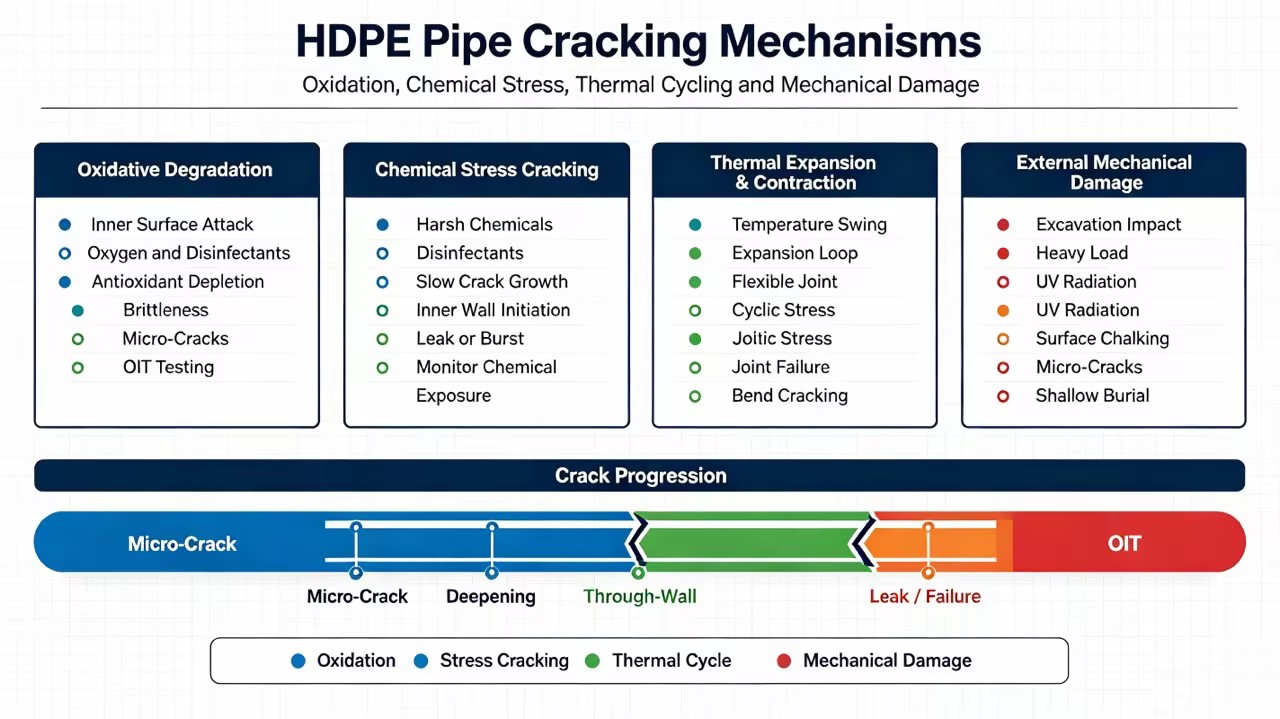
Oxidation breaks down HDPE’s molecular chains, reducing strength and flexibility. This happens mainly on the pipe’s inner surface where water and disinfectants contact the material. Antioxidants in the pipe slow oxidation but get used up over time. Once depleted, the pipe becomes brittle, leading to cracks that grow under pressure. Temperature speeds up oxidation, so hotter environments worsen the problem.
Stress Cracking from Chemical Exposure
Certain chemicals cause stress cracking by attacking the pipe material. HDPE resists many substances but prolonged exposure to harsh chemicals or disinfectants can create tiny cracks. Over years, these cracks enlarge, risking leaks or bursts. Stress cracking often starts inside the pipe wall, invisible until failure occurs. Monitoring chemical exposure helps catch this early.
Thermal Expansion and Contraction Effects
HDPE pipes expand and contract as temperatures change. Without room for movement, this causes stress, especially at joints or bends. Repeated cycles of expansion and contraction weaken the pipe, causing cracks or joint failures. Areas with big temperature swings need special design considerations like expansion loops or flexible joints.
Improper Installation and Construction Errors
Errors during installation are a common cause of cracking. Poor heat fusion welding creates weak joints prone to cracking under pressure. Uneven bedding or foundation settlement stresses the pipe unevenly, causing deformation and cracks. Rough handling or damage during laying can create micro-cracks that grow over time. Skilled labor following strict procedures reduces these risks.
External Mechanical Damage and Environmental Factors
HDPE pipes can crack from external impacts such as excavation equipment, rocks, or heavy loads above ground. Environmental exposure like UV radiation degrades pipe surfaces, making them brittle and crack-prone. Pipes buried too shallowly or left exposed face higher damage risk. Proper burial depth and protective coatings help prevent this.
Material Quality and Manufacturing Defects
Low-quality raw materials or manufacturing flaws lead to uneven polymer structure and weak spots. These defects reduce pipe toughness and resistance to cracking. Inconsistent antioxidant distribution or impurities accelerate degradation. Using certified, high-grade HDPE with strict quality control minimizes this cause.
Tip: Always ensure HDPE pipes come from reputable manufacturers with verified quality standards to reduce cracking risks caused by material defects.
Role of Oxidation in HDPE Pipe Cracking
Mechanism of Oxidative Degradation in HDPE
Oxidative degradation happens when oxygen molecules attack the HDPE polymer chains. This breaks the chains into smaller segments, weakening the pipe’s structure. The process is most aggressive on the pipe’s inner surface because it’s in constant contact with water and dissolved oxygen. Over time, this causes the material to lose flexibility and become brittle, making it prone to cracking under pressure or stress.
Effect of Antioxidants and Their Depletion Over Time
Manufacturers add antioxidants to HDPE pipes to slow oxidation. These antioxidants neutralize harmful free radicals that start chain breakdown. However, antioxidants are a limited resource within the pipe. Flowing water and disinfectants gradually wash them away or consume them in chemical reactions. Once antioxidants near the surface are depleted, the pipe’s inner layer becomes vulnerable to rapid oxidation. This leads to embrittlement and crack formation. The antioxidants in the pipe’s core migrate outward to replace lost ones, but this supply eventually runs out too.
Impact of Water Disinfectants on Pipe Inner Surfaces
Water disinfectants like chlorine or chloramine act as oxidizing agents. They accelerate the degradation of HDPE by reacting with the pipe’s inner surface. Constant exposure to these chemicals intensifies the breakdown of polymer chains. This chemical attack reduces molecular weight and mechanical strength locally, making the pipe wall brittle. Over years, this results in micro-cracks that grow under internal pressure until failure occurs.
Signs and Progression of Oxidation-Induced Cracks
Oxidation-induced cracks often start as tiny hairline fractures on the inner surface. These are usually invisible during routine inspections. As oxidation progresses, cracks deepen and widen, eventually penetrating through the pipe wall. The pipe loses ductility and can fail suddenly without much warning. Signs include discoloration, surface roughness inside the pipe, and reduced flexibility. Pressure cycling and mechanical stress accelerate crack growth once initiated.
Tip: Regularly test HDPE pipes for antioxidant levels using Oxidation Induction Time (OIT) methods to predict oxidation risk and schedule timely maintenance.
Impact of Installation and Construction on HDPE Pipe Cracking
Proper installation and construction play a crucial role in preventing HDPE pipe cracking. Mistakes or shortcuts during these phases often cause early failures. Let’s explore the main installation-related factors leading to cracks.
Heat Fusion Joint Failures and Their Contribution to Cracking
Heat fusion welding connects HDPE pipe sections by melting their ends and pressing them together. When done correctly, this creates a strong, seamless joint. However, poor heat fusion practices weaken joints and cause cracking:
Incorrect heating temperature or time leads to incomplete melting or burning.
Uneven pressure during fusion causes weak bonding or voids.
Contamination on pipe ends reduces joint strength.
Lack of proper cooling time before handling stresses the joint.
Weak or flawed heat fusion joints become the first points of failure under pressure or thermal cycling. Cracks often start at these joints and propagate into the pipe wall. Skilled welders following strict procedures and quality checks prevent such failures.
Consequences of Uneven Foundation Settlement and Pipeline Deformation
The soil beneath a pipeline must be stable and evenly compacted. Uneven foundation settlement causes the pipe to bend or deform. This deformation creates localized stress points, increasing crack risk:
Soft or loose backfill allows uneven sinking.
Heavy loads or traffic above poorly supported pipes cause bending.
Pipeline sections spanning gaps experience sagging and tensile stress.
Over time, repeated stress from uneven support weakens the pipe wall. Cracks initiate at high-stress zones, especially near joints or bends. Proper site preparation and soil compaction are essential to avoid these problems.
Effects of Improper Handling and External Damage During Installation
HDPE pipes are flexible but can suffer damage during transport and installation:
Dropping or dragging pipes over sharp objects causes scratches or micro-cracks.
Using heavy machinery carelessly can dent or deform pipes.
Exposure to sunlight without UV protection during storage weakens the surface.
Even minor surface damage creates weak spots where cracks can start. These defects worsen under pressure and temperature changes. Careful handling, storage under shade, and protective measures reduce such risks.
Importance of Skilled Labor and Adherence to Construction Procedures
Successful installation depends heavily on trained, experienced workers who follow established guidelines:
Proper fusion welding techniques ensure strong, crack-resistant joints.
Correct bedding and backfill methods prevent uneven settlement.
Careful pipe handling avoids damage.
Regular inspections during construction catch early defects.
Training programs, certification, and supervision improve workmanship quality. Following manufacturer and industry standards minimizes installation-related cracking.
Tip: Invest in skilled installers and enforce strict quality controls during HDPE pipe laying to prevent costly cracking caused by poor fusion joints and uneven foundation support.
Environmental and Operational Factors Leading to HDPE Pipe Cracking
HDPE pipes face many challenges from their surroundings and how they operate. These factors often cause or speed up cracking. Understanding each helps prevent damage and extend pipe life.
UV Degradation in Exposed HDPE Pipes
Sunlight, especially UV rays, breaks down HDPE over time. Pipes exposed above ground suffer the most. UV rays attack the pipe’s surface, making it brittle and prone to cracks. This damage starts as surface chalking or discoloration and worsens with continued exposure. Over months or years, the pipe loses flexibility and strength.
Adding carbon black or UV stabilizers during manufacturing helps protect pipes. Still, prolonged exposure without shielding requires extra care. Covering pipes or burying them reduces UV damage risk.
Pressure Surges and Water Hammer Effects
Sudden changes in water pressure create pressure surges or water hammer. These shocks produce intense stress inside pipes. Repeated pressure spikes cause fatigue cracks, especially near fittings or bends. Even pipes designed for high pressure can weaken if surges happen often.
Installing surge arrestors or pressure relief valves helps control these effects. Operators should monitor pressure changes and avoid rapid valve closures that cause water hammer.
Temperature Fluctuations and Their Stress on Pipes
HDPE pipes expand when hot and contract when cold. Large temperature swings cause repeated expansion and contraction cycles. Without room to move, pipes develop stress points at joints or bends. Over time, this leads to cracking or joint failure.
In colder climates or places with big day-night temperature changes, designers include expansion loops or flexible joints. Proper bedding also reduces stress from movement.
Chemical Exposure and Its Role in Stress Cracking
Though HDPE resists many chemicals, some cause stress cracking. Prolonged contact with aggressive chemicals or disinfectants weakens the pipe wall. Cracks start small inside the pipe and grow under pressure. This cracking is often invisible until failure occurs.
Operators must know what chemicals flow through their pipes. Limiting exposure to harmful substances and monitoring pipe condition helps catch early signs of stress cracking.
Tip: Shield exposed HDPE pipes from sunlight using UV-resistant coatings or burial, and install surge protection devices to minimize cracking caused by environmental and operational stress.
Detection and Monitoring of HDPE Pipe Cracking
Detecting and monitoring cracks early in HDPE pipes is vital to avoid sudden failures. Regular checks help catch problems before they worsen, saving time, money, and preventing service interruptions.
Visual Inspection and Common Signs of Cracking
Visual inspection is the first and simplest way to spot cracks. Look for:
Hairline fractures or surface crazing on exposed pipe sections
Discoloration, chalking, or rough patches indicating oxidation or UV damage
Deformed or bulging areas, especially near joints or bends
Leakage or damp spots around fittings or pipe surfaces
Inspect buried pipes during maintenance digs or when exposed. For above-ground pipes, schedule routine checks, especially in harsh environments. Early signs might be subtle, so trained eyes are essential.
Use of Oxidation Induction Time (OIT) Testing
OIT testing measures the remaining antioxidant levels in HDPE pipes. Antioxidants protect pipes from oxidation, so low OIT means higher risk of cracking. This test uses differential scanning calorimetry (DSC) to detect when oxidation starts under heat.
Regular OIT testing of pipe samples can:
Predict the pipe’s remaining service life
Identify areas with accelerated aging due to chemical exposure
Help schedule timely maintenance or replacement
OIT testing is a powerful tool for proactive pipe management.
Regular Maintenance and Inspection Protocols
Establish a maintenance schedule that includes:
Routine visual inspections every 6 to 12 months
OIT testing of pipe samples from critical sections every few years
Pressure testing to detect leaks or weak points
Documentation of inspection findings for trend analysis
Following strict protocols ensures consistent monitoring and early problem detection.
Technological Tools for Early Crack Detection
Advanced tools can detect cracks invisible to the eye:
Acoustic Emission Sensors: Detect sound waves from crack growth or leaks
Ultrasonic Testing: Measures pipe wall thickness and detects internal flaws
Infrared Thermography: Spots temperature differences indicating leaks or cracks
Smart Pigs: Devices sent through pipelines to scan for defects
Using technology complements visual checks and improves detection accuracy.
Tip: Combine regular visual inspections with OIT testing and advanced sensor technologies for comprehensive early detection of HDPE pipe cracks, ensuring timely maintenance and preventing costly failures.
Prevention Strategies for HDPE Pipe Cracking
Preventing cracks in HDPE pipes requires a combination of good materials, proper installation, and ongoing care. Addressing these areas lowers the risk of failure and extends pipe life.
Material Selection and Quality Control Measures
Choosing high-quality HDPE pipes is the first defense against cracking. Look for pipes made from certified resins with consistent antioxidant packages. Quality control during manufacturing ensures even distribution of additives like UV stabilizers and antioxidants that protect the pipe. Avoid pipes with visible defects or from unverified suppliers. Testing samples for Oxidation Induction Time (OIT) can confirm antioxidant levels, predicting durability.
Proper Installation Techniques and Skilled Workforce Training
Correct installation is critical. Skilled workers trained in heat fusion welding produce strong, crack-resistant joints. Strictly follow manufacturer fusion parameters—temperature, pressure, and timing—to avoid weak spots. Ensure proper handling to prevent scratches or dents. Bedding should be uniform and compacted to support pipes evenly and prevent deformation. Use expansion loops or flexible joints in areas with large temperature swings to accommodate pipe movement.
Use of Protective Additives and Antioxidants
Incorporate additives like antioxidants and UV stabilizers during pipe production. Antioxidants slow oxidative degradation inside the pipe, while UV stabilizers protect exposed surfaces from sunlight damage. Some formulations include carbon black, which offers excellent UV resistance. Regularly monitor antioxidant levels in service to plan maintenance or replacement before cracks develop.
Environmental Protection Measures Including UV Shielding
Prevent direct sunlight exposure for above-ground pipes. Use protective coatings, wraps, or bury pipes to shield them from UV radiation. Where burial isn't possible, UV-resistant covers or paints help maintain pipe flexibility. Avoid leaving pipes exposed during storage or installation. Environmental protection reduces surface embrittlement and cracking risks.
Pressure Regulation and Surge Protection
Control internal pressure to prevent stress cracks. Install surge arrestors, pressure relief valves, or air chambers to dampen water hammer effects. Avoid rapid valve closures and sudden flow changes. Regularly inspect pressure systems to detect spikes that may weaken pipe walls. Keeping pressure stable reduces fatigue cracks near joints and bends.
Routine Maintenance and Timely Repairs
Establish a maintenance schedule including visual inspections and OIT testing. Early detection of surface damage or antioxidant depletion allows for timely repairs. Fix small cracks or weak joints before they grow. Clean pipes to remove chemical residues that accelerate degradation. Document maintenance activities to track pipe health over time.
Tip: Train installation teams thoroughly and enforce strict quality checks on materials and workmanship to prevent HDPE pipe cracking caused by poor fusion joints and uneven support.
Repair Methods for HDPE Pipe Cracking
When HDPE pipes crack, timely and effective repair is crucial to restore function and prevent further damage. Repair methods generally fall into two categories: those requiring water supply interruption and pipe cutting, and those that allow repairs without cutting or shutting down the system.
Repair After Water Supply Interruption: Cutting and Jointing
This traditional repair method involves shutting off the water supply, cutting out the damaged pipe section, and replacing it with a new piece. Key steps include:
Shutting off Water Supply: Isolate the affected pipeline section by closing valves upstream and downstream to prevent water flow during repair.
Cutting the Damaged Section: Remove the cracked or damaged pipe segment carefully to avoid further damage.
Preparing Pipe Ends: Clean and bevel the pipe ends to ensure a smooth, clean surface for jointing.
Jointing Techniques: Use heat fusion welding, electrofusion fittings, or mechanical couplings to connect the new pipe segment. Proper welding parameters and joint preparation are critical for a strong, leak-proof repair.
Pressure Testing: After jointing, test the repaired section under pressure to ensure integrity before restoring water flow.
This approach is reliable and suitable for extensive damage but requires service interruption and skilled labor.
No-Cut, No-Shutdown Repair Techniques Using Repair Kits
For urgent repairs or when service interruption is impractical, repair kits offer a convenient solution. These kits usually consist of a stainless steel clamp or sleeve lined with a rubber gasket that seals cracks or leaks without cutting the pipe.
Advantages include:
No Water Shutdown Required: Repairs can be made while the pipe remains in service, minimizing downtime.
Quick and Easy Installation: Kits are lightweight and easy to apply with minimal tools.
Versatility: Effective for various crack types, pinholes, and small leaks.
Reusable Options: Some kits can be removed and reapplied if needed.
However, these kits are generally suited for minor damage and may not be a permanent fix for large or severe cracks.
Advantages and Limitations of Different Repair Approaches
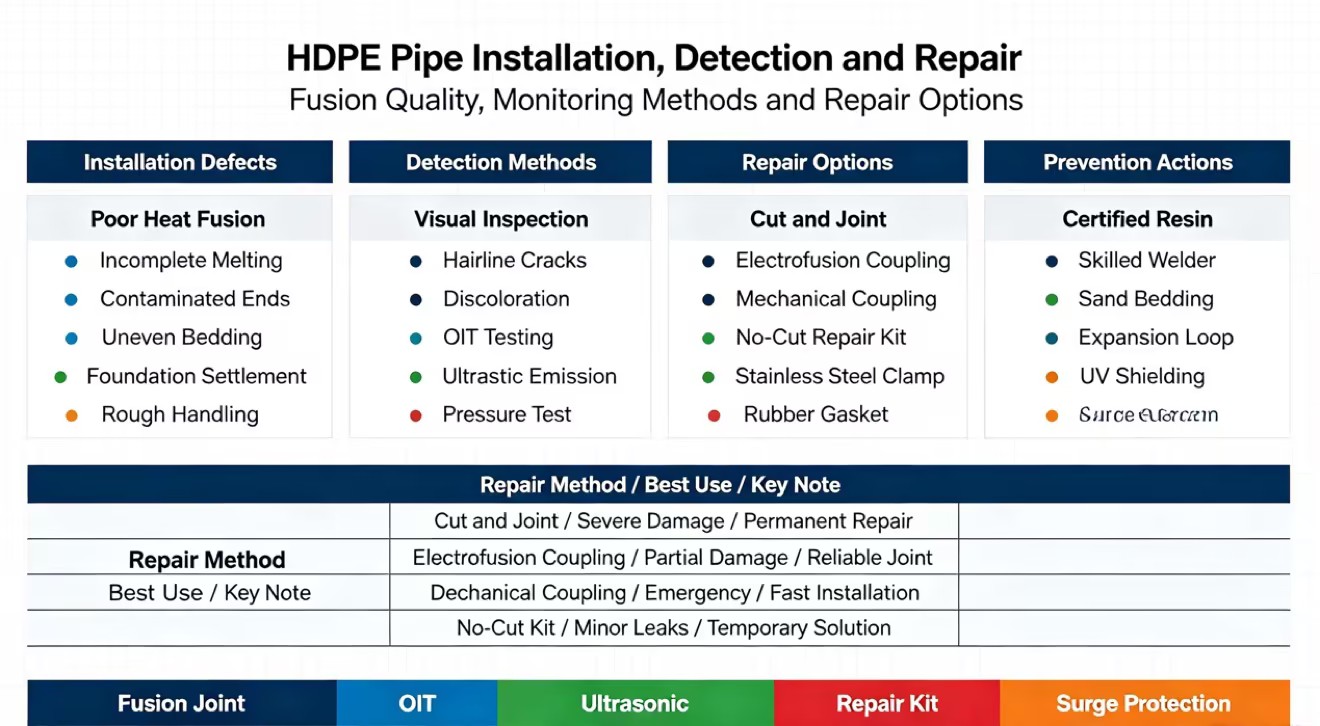
Repair Method | Advantages | Limitations |
|---|---|---|
Cutting and Jointing | Strong, permanent repair; suitable for large damage | Requires water shutdown; labor-intensive |
No-Cut, No-Shutdown Repair Kits | Fast, convenient; no service interruption | Limited to small cracks; may be temporary |
Electrofusion Couplings | Reliable joint quality; good for partial damage | Needs specialized equipment and training |
Mechanical Couplings | Quick installation; useful for emergencies | May not be as durable as fusion joints |
Selecting the right method depends on damage severity, location, available resources, and operational constraints.
Emergency Repair Best Practices and Safety Considerations
During emergency repairs, safety and efficiency are paramount:
Assess Damage Quickly: Determine crack size and location to choose the best repair method.
Ensure Proper Isolation: For cutting repairs, confirm valves fully close to prevent water flow.
Use Trained Personnel: Skilled workers reduce risk of joint failure or further damage.
Follow Manufacturer Guidelines: Adhere to repair kit or jointing system instructions carefully.
Maintain Safety Protocols: Use personal protective equipment and follow site safety rules.
Document Repairs: Record repair details for future maintenance and inspection.
Prompt, well-executed repairs minimize downtime and extend pipe service life.
Tip: Keep a stock of no-cut repair kits on hand for quick fixes, but plan for permanent repairs during scheduled downtime to ensure long-term pipeline integrity.
Conclusion
HDPE pipe cracking results from oxidation, stress, poor installation, and environmental factors. Preventing cracks requires quality materials, skilled installation, and protective measures. Proactive maintenance and monitoring, including antioxidant testing and inspections, help catch issues early. Innovations in pipe technology continue improving durability and resistance. POLYGON offers high-quality HDPE pipes designed for longevity and reliability, backed by expert support to ensure your pipeline’s optimal performance and extended service life. Trust POLYGON for durable, crack-resistant solutions.
FAQ
Q: What causes HDPE pipe cracking?
A: HDPE pipe cracking is mainly caused by oxidative degradation, stress from chemical exposure, thermal expansion, improper installation, mechanical damage, and material defects.
Q: How does oxidative degradation lead to HDPE pipe cracking?
A: Oxidative degradation breaks down polymer chains in HDPE pipes, making them brittle and prone to cracking, especially on the inner surface exposed to water and disinfectants.
Q: Can improper installation cause HDPE pipe cracking?
A: Yes, poor heat fusion joints, uneven foundation, and rough handling during installation can create weak points that lead to HDPE pipe cracking.
Q: How can HDPE pipe cracking be prevented?
A: Prevention includes using high-quality materials, skilled installation, protective additives, UV shielding, pressure regulation, and routine maintenance.
Q: What are common repair methods for HDPE pipe cracking?
A: Repairs include cutting and jointing after water shutdown or using no-cut repair kits for minor cracks without shutting down the system.
Related Articles


CONTACT
Get in Touch With Us